B2B Procurement Guide for Cold-Climate Patio Chairs: Material Weatherability and EN581 Certification Standards

Jump to section
For procurement managers at northern hotels, ski resorts, waterfront restaurants, and regional furniture distributors, outdoor patio furniture selection goes far beyond aesthetics and unit price. When temperatures plunge below freezing, snow loads accumulate on terraces, and de-icing salt spray coats every exposed surface, the physical properties of your furniture materials will determine asset lifespan and total cost of ownership.
This guide approaches cold-climate furniture procurement from the perspective of materials science and industrial testing standards, giving B2B buyers an evidence-based framework for evaluating all-weather patio chair suppliers and making defensible purchasing decisions.
How Cold and Extreme Climates Damage the Physical Structure of Outdoor Patio Furniture
Before evaluating any specific material, procurement teams need to understand the distinct physical forces that cold climates impose on outdoor furniture. Temperature, moisture, and wind act as a compound stress system, and different materials respond to that system in fundamentally different ways.
Why Does Resin Wicker Become Brittle and Crack in Low Temperatures?
Resin wicker is made from thermoplastic polymers — typically polyethylene (PE) or polypropylene (PP). Every polymer has a critical parameter known as its glass transition temperature (Tg). When the ambient temperature drops below Tg, molecular chain movement is effectively frozen. The material shifts from a flexible, rubbery state to a rigid, glass-like state, and brittleness increases dramatically.
For low-grade recycled PE wicker, Tg can fall in the range of −20°C to −30°C (−4°F to −22°F). Winter extremes across the northern United States, Canada, and the upper Midwest routinely reach or exceed these thresholds. Once the material enters its brittle state, the static load of accumulated snow or even minor bending during a mid-winter repositioning can propagate microcracks through the weave, ultimately causing large-scale structural failure.
A critical gap in the supply chain is that many manufacturers do not disclose Tg values in their spec sheets. Without independent third-party test data, buyers have no reliable way to verify whether a resin wicker product can survive an entire winter outdoors.
How Do Freeze-Thaw Cycles Cause Solid Wood Furniture to Rot?
Wood is a porous natural material. Its cell walls and cell cavities readily absorb moisture from rainfall, snowmelt, and ambient humidity. During the transitional seasons — late fall through early spring — daytime warming allows wood to absorb water; overnight temperature drops below 32°F (0°C) cause that absorbed water to freeze and expand in volume by approximately 9%.
This repeated freeze-thaw cycling inflicts progressive, irreversible structural damage. Each ice crystal expansion widens the micro-fissures between wood fibers, allowing even more water to enter during the next thaw. Over the course of a single winter — often involving dozens to hundreds of freeze-thaw cycles — the internal structure of the wood becomes severely compromised. When spring arrives and humidity rises, the loosened fibers create an ideal environment for fungal colonization, and rot accelerates.
Even pressure-treated softwoods such as ACQ-treated pine struggle to maintain structural integrity beyond 3–5 years in harsh freeze-thaw environments, and they require periodic reapplication of sealants and preservative oils throughout that period — an ongoing maintenance cost that erodes any upfront price advantage.
Wind Load Requirements for Commercial Patio Chairs in High-Wind Regions
Cold-climate regions frequently experience high wind speeds. Across the northern Great Plains, the Great Lakes corridor, and coastal New England, winter gust speeds regularly reach 40–55 mph (65–90 km/h), with blizzard conditions occasionally exceeding 60 mph (100 km/h).
In commercial settings, a patio chair blown across a terrace is not merely an asset loss — it is a serious liability. Airborne metal-frame chairs can shatter plate glass, damage parked vehicles, and injure pedestrians. Northern B2B procurement must therefore incorporate chair self-weight and wind resistance into the selection criteria alongside corrosion resistance. As a practical benchmark, commercial-grade patio chairs should weigh no less than 9–11 lbs (4–5 kg) per unit. For open, unsheltered terraces, 18 lbs (8 kg) and above provides a significantly better safety margin. Lightweight plastic chairs and thin-wall aluminum tube chairs are inherently disadvantaged on this metric.
Can Aluminum Furniture Stay Outside in Winter?
This is one of the most frequently searched questions among North American B2B furniture buyers — and the answer is clear: yes. Aluminum is among the most weather-resilient materials available for commercial outdoor furniture, and that resilience stems from two properties rooted in metallurgy.
How Aluminum Performs Against Freeze-Cracking at Sub-Zero Temperatures
Unlike carbon steel and cast iron, aluminum alloys do not exhibit a significant ductile-to-brittle transition at low temperatures. Carbon steel’s body-centered cubic (BCC) crystal lattice restricts dislocation movement as temperatures drop, causing sudden embrittlement — a phenomenon that contributed to the catastrophic hull failures of Liberty ships during World War II. Aluminum alloys, by contrast, have a face-centered cubic (FCC) lattice structure. At low temperatures, FCC metals actually see a modest increase in yield strength while retaining their ductility.
This means aluminum furniture maintains its structural toughness even at −40°F / −40°C — the point where Fahrenheit and Celsius converge — without any risk of sudden brittle fracture. Additionally, aluminum naturally forms a thin but dense oxide layer (Al₂O₃) upon exposure to air. Though only 2–10 nm thick, this passive film effectively blocks oxygen and moisture, giving aluminum inherent rust immunity. This is a critical advantage over ferrous metals in any outdoor application.
Cast Aluminum vs. Standard Aluminum Tube: Stability in Winter Winds
Aluminum’s light weight is an advantage during setup and repositioning, but it can become a liability in high-wind environments. This is precisely why cast aluminum patio chairs have gained strong preference among northern hospitality buyers.
Standard aluminum tube furniture typically uses wall thicknesses of 1.0–1.5 mm, producing chairs weighing as little as 5–7 lbs (2–3 kg) — far too light for exposed commercial terraces during winter storms. Cast aluminum manufacturing, by contrast, forces molten aluminum under high pressure into precision molds, producing components with greater and more uniform wall thickness and higher overall density. A typical cast aluminum dining chair weighs 11–18 lbs (5–8 kg), achieving the optimal balance between aluminum’s corrosion resistance and the self-weight needed to resist wind displacement.
Cast construction also enables complex one-piece structural designs that eliminate welded joints. Welded joints are potential weak points in freeze-thaw environments because differential thermal expansion at the weld zone can create stress concentrations over repeated temperature cycles. One-piece cast frames remove this failure mode entirely.
How Powder Coating Protects All-Weather Patio Chairs Against Weathering
Aluminum’s natural oxide film provides a baseline level of corrosion resistance, but in the compound environment of de-icing salt, acid rain, and sustained UV exposure common to northern climates, the passive oxide layer alone is insufficient. Industrial-grade surface treatment is the essential second line of defense.
How De-Icing Salt Corrodes Unprotected Metal Furniture Frames
De-icing salt — primarily sodium chloride (NaCl) or calcium chloride (CaCl₂) — is a routine winter maintenance measure on roads, sidewalks, and building perimeters across the northern United States and Canada. Salt-laden snowmelt splashes, drips, and pools around patio furniture legs and frame joints. Once in contact with a metal surface, chloride ions (Cl⁻) penetrate weak or damaged surface layers and initiate localized electrochemical corrosion.
On unprotected carbon steel, this manifests as rapid pitting and flaking rust. On aluminum, while overall corrosion resistance is superior to steel, concentrated chloride ions can still breach the natural oxide film and trigger pitting corrosion. Regardless of how inherently corrosion-resistant a base metal may be, a physical barrier coating that isolates the metal from external corrosive agents is indispensable.
How Military-Grade Powder Coating Blocks Oxidation and Moisture Penetration
The powder coating manufacturing process differs fundamentally from conventional liquid paint application. It involves three critical stages:
Pre-treatment: Aluminum frames undergo alkaline degreasing, acid pickling to remove surface oxides, and then a chromate or zirconium conversion coating. This conversion layer forms a chemically bonded, nanoscale inorganic film on the aluminum surface that dramatically improves adhesion between the base metal and the subsequent powder coat.
Electrostatic application: Dry thermosetting resin powder — typically polyester or an epoxy-polyester hybrid system — is electrically charged under a high-voltage electrostatic field and uniformly attracted to the grounded aluminum frame. Because adhesion is electrostatic rather than gravitational, the coating achieves far greater uniformity than liquid spray methods, with none of the sagging, dripping, or orange-peel texture associated with wet paint.
High-temperature curing: Coated frames enter a curing oven at 356–392°F (180–200°C), where the powder particles melt, flow together, and undergo a cross-linking polymerization reaction. The result is a continuous, dense, pinhole-free cured film with a typical thickness of 60–100 μm (2.4–4.0 mils).
The critical performance attribute of this cured film is its seamlessness. Unlike liquid coatings, which inevitably trap micro-bubbles and form pinholes as solvents evaporate, powder-coated films are exceptionally dense. This density blocks the three primary agents of corrosion — water vapor, chloride ions, and oxygen — from reaching the aluminum substrate. It is this mechanism that allows properly powder-coated furniture to maintain coating integrity through years of salt spray, ice accumulation, and UV bombardment, and it is the reason powder-coated furniture does not suffer from the peeling and flaking that plagues conventional painted finishes.
International Testing and Compliance Standards for Outdoor Furniture in Northern Climates
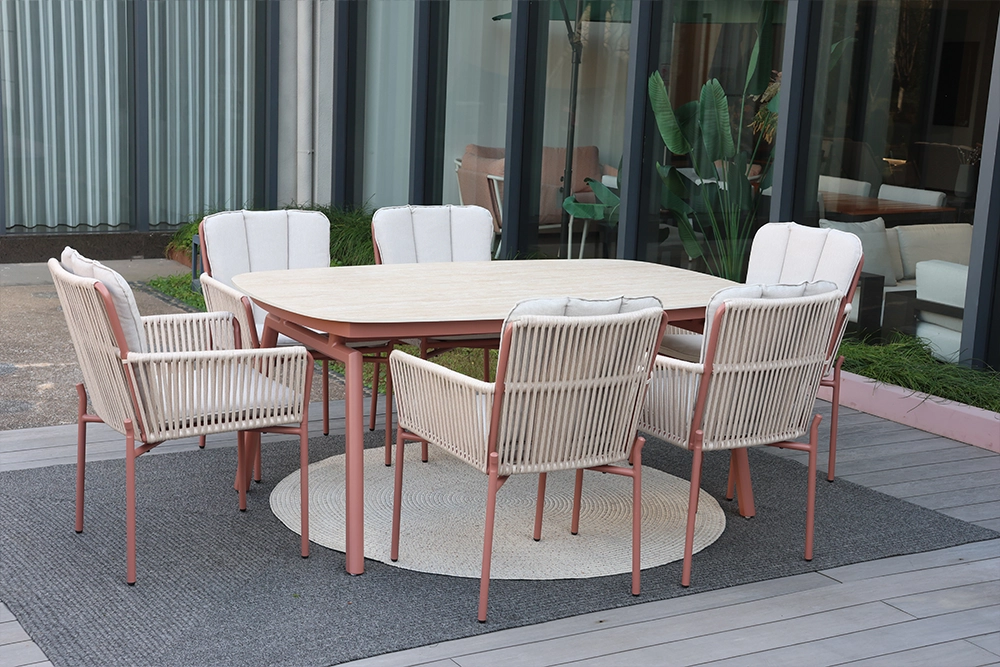
Material advantages and manufacturing processes ultimately need to be validated through objective, third-party standards. For B2B procurement, certifications and test reports are the definitive tools for verifying supplier claims.
What EN581 Certification Requires for Commercial All-Weather Patio Chairs
EN581 is a performance standard developed by the European Committee for Standardization (CEN) specifically for commercial outdoor seating and table products. While European in origin, EN581 certified outdoor furniture has become a widely recognized benchmark among quality-conscious North American buyers, particularly in the hospitality sector. The standard addresses several critical dimensions:
Structural safety (EN581-1): Defines minimum dimensional requirements, stability criteria, and load-bearing capacity, ensuring products meet baseline safety expectations for commercial environments such as restaurant patios, hotel terraces, and café seating areas.
Mechanical strength and durability (EN581-2/3): Validates seat, backrest, armrest, and leg structures through simulated real-use cyclic loading tests. Commercial-grade testing (Level 2) is significantly more demanding than residential-grade — chair seats must withstand a minimum of 100,000 load cycles without structural failure.
Weathering resistance: While the core EN581 standard focuses on mechanical performance, it is complemented by material-specific weathering standards such as UV aging tests (ISO 4892) and salt spray tests (ISO 9227), which together form a comprehensive weatherability assessment.
For B2B procurement teams, the practical value of EN581 certification lies in comparability. When evaluating competing suppliers, an EN581 test report provides an objective, apples-to-apples benchmark that moves the conversation beyond subjective claims of “premium quality” into verifiable performance data.
Simulated Extreme Weather Testing: Salt Spray and Waterproofing Protocols
To verify that “all-weather” is an engineering reality and not a marketing phrase, quantifiable test data is essential. Two industry-standard tests are particularly relevant to cold-climate applications:
Neutral salt spray test (NSS, ISO 9227): Finished, fully coated frames are placed inside a salt spray chamber and continuously exposed to a 5% NaCl saline mist, simulating years of coastal or de-icing salt exposure in an accelerated timeframe. The industry-standard pass threshold is typically 500 hours with no significant corrosion. High-performance products target 1,000 hours or more. Sunshine products undergo salt spray testing exceeding 1,000 hours, with post-test inspections confirming no blistering, no delamination, and no corrosion penetration of the coating.
Immersion and humidity cycling tests: These simulate prolonged water contact and high-humidity conditions, evaluating coating adhesion and substrate corrosion resistance. Advanced protocols also include artificial scratch tests followed by corrosion spread assessments, verifying that even if the coating is locally damaged, corrosion does not propagate rapidly along the coating-substrate interface.
The specific data from these tests — hours of exposure, rating grades, and the identity of the accredited testing laboratory — are the core documents that procurement teams should request from any supplier claiming all-weather performance.
Sunshine Outdoor: A Patio Chair Manufacturer Built for Cold-Climate Standards
The analysis above reveals a three-layer logic for cold-climate outdoor furniture selection. The first layer is base material physics — aluminum alloy, with its FCC crystal lattice and natural oxide passivation, delivers low-temperature toughness and inherent corrosion resistance. The second layer is surface engineering — military-grade powder coating creates a seamless, dense barrier film that blocks salt spray and moisture from reaching the substrate. The third layer is standards verification — EN581 certification and salt spray test reports provide the quantifiable, third-party-validated evidence that procurement decisions require.
Sunshine Outdoor’s product line is engineered around all three layers: high-strength cast aluminum frames deliver stability and freeze-crack immunity, a rigorous powder coating process provides all-weather corrosion protection, and EN581 and ISO-standard testing provides documented proof of performance for every production batch.
If you are sourcing all-weather patio chairs for northern hotels, high-latitude resorts, or regional furniture distribution, contact our team for a custom quote and complete test documentation to bring data-driven confidence to your next procurement decision.
Want to Know More About Our Products?
View All Products NowAbout Author
Spring Nee
Spring Nee is the Sales & Marketing Director at Zhejiang Sunshine Leisure Products Co., Ltd. With nearly 20 years of experience in the outdoor leisure furniture industry, she specializes in camping chairs, beach chairs, folding outdoor seating, and OEM/ODM project communication. Spring also leads the company’s marketing content direction. Most of the articles published on this website are either written by Spring herself or reviewed by her before publication, ensuring that the content is practical, accurate, and based on real industry experience.