OEM vs ODM Outdoor Furniture: Which Model Is Right for Your Brand?

Jump to section
OEM outdoor furniture is a manufacturing model that produces products based on the buyer’s own designs, while ODM outdoor furniture is a model that offers pre-developed designs the buyer can customize and rebrand. Choosing between them depends on a brand’s design capability, budget, and time-to-market goals. This guide breaks down both models to help outdoor furniture buyers make the right sourcing decision.
What Is OEM Outdoor Furniture and How Does It Work?

OEM outdoor furniture is a production arrangement that allows brands to provide their own proprietary designs to a manufacturer, who then produces the finished goods to exact specifications. This model gives brands full control over product design, materials, and construction details, making it the preferred choice for companies with established in-house design teams.
What Does the OEM Process Look Like from Design to Delivery?
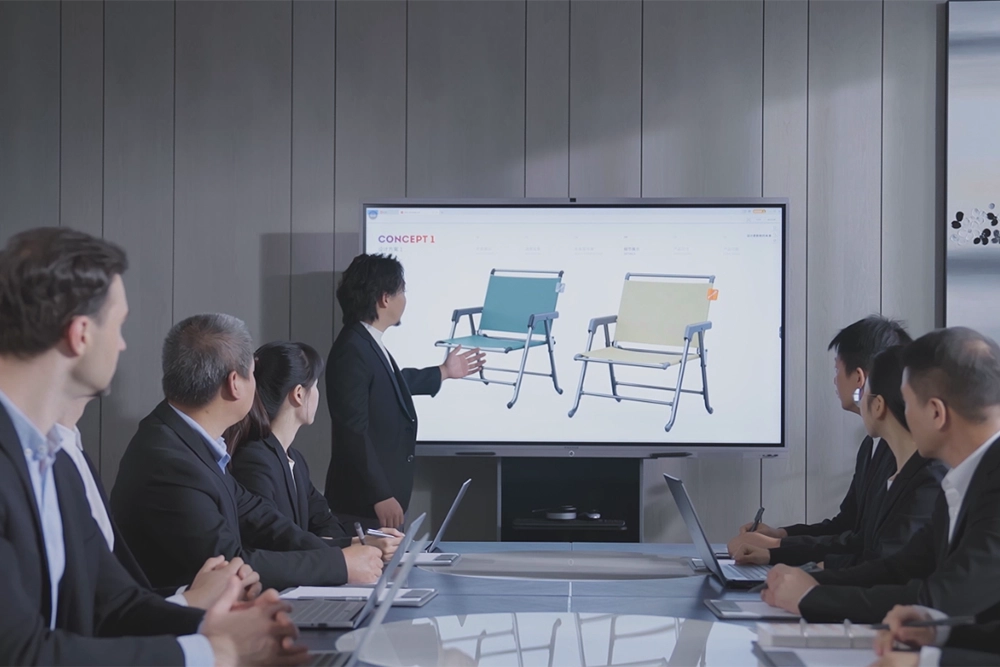
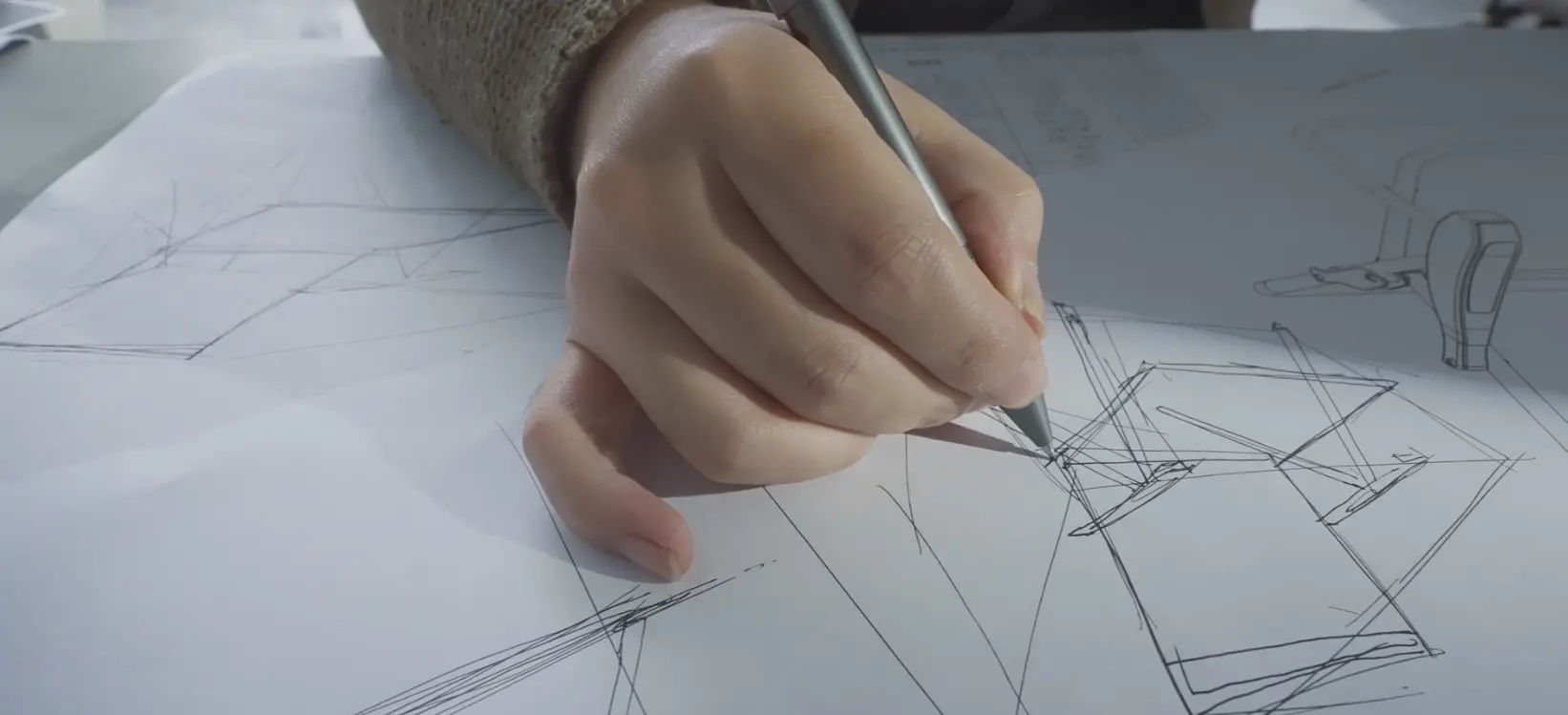
The OEM process follows a structured workflow from concept to shipment. First, the brand submits product designs including CAD drawings, material specifications, and dimensional tolerances. The manufacturer evaluates feasibility and provides engineering feedback. Next comes material selection — brands can specify options such as FSC-certified wood, powder-coated aluminum, or UV-resistant fabrics. After both parties confirm specifications, the manufacturer produces prototypes for approval. Once the sample is signed off, bulk production begins with quality inspections at every stage. The entire cycle from design submission to first shipment typically spans 45 to 90 days. Manufacturers offering a complete OEM and ODM service can guide brands through each stage with dedicated project management.
What Types of Outdoor Furniture Are Commonly Produced Under OEM?
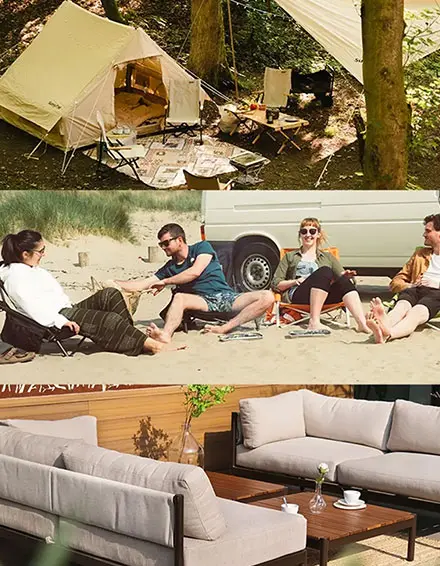
OEM production covers virtually every outdoor furniture category. Common product types include camping chairs and folding tables, beach loungers and deck chairs, and garden sofa sets, dining collections, and rocking chairs. Brands with mature product lines and clear design identities tend to use OEM for their signature collections, where design exclusivity directly supports premium pricing.
What Is ODM Outdoor Furniture and Why Do Brands Choose It?
ODM outdoor furniture is a manufacturing model that provides ready-made product designs which buyers can select, modify, and sell under their own brand. This approach significantly reduces development time and upfront investment while still offering meaningful customization — making it attractive for brands that prioritize speed and cost efficiency over design originality.
How Does the ODM Collaboration Process Typically Work?
The ODM collaboration begins with the buyer browsing the manufacturer’s existing product catalog. Buyers select designs that align with their market positioning and request modifications such as color changes, fabric swaps, logo placement, and packaging customization. The manufacturer then produces a confirmation sample, and once approved, moves directly into bulk production. Because the design and engineering phases are already complete, ODM orders can move from selection to delivery in roughly 30 to 60 days.
What Customization Options Are Available in an ODM Partnership?
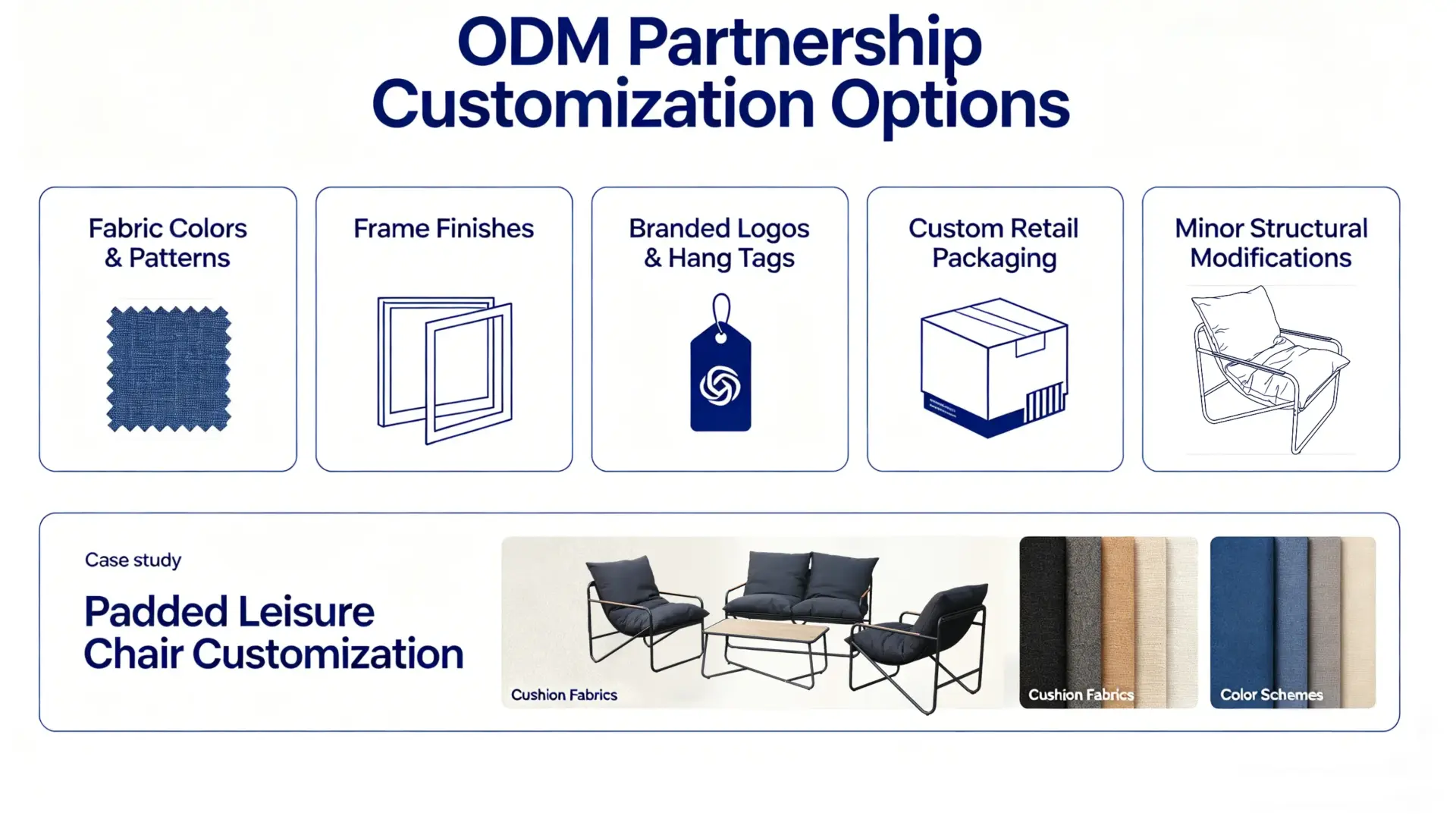
ODM partnerships offer a meaningful range of customization despite using existing base designs. Buyers can typically adjust fabric colors and patterns, select alternative frame finishes, add branded logos and hang tags, and design custom retail packaging. Some manufacturers also allow minor structural modifications such as adjusting seat height or adding armrest padding. For instance, a padded leisure chair collection can be customized with different cushion fabrics and color schemes to match a brand’s visual identity, even though the base frame design remains standardized.
What Are the Key Differences Between OEM and ODM Outdoor Furniture?
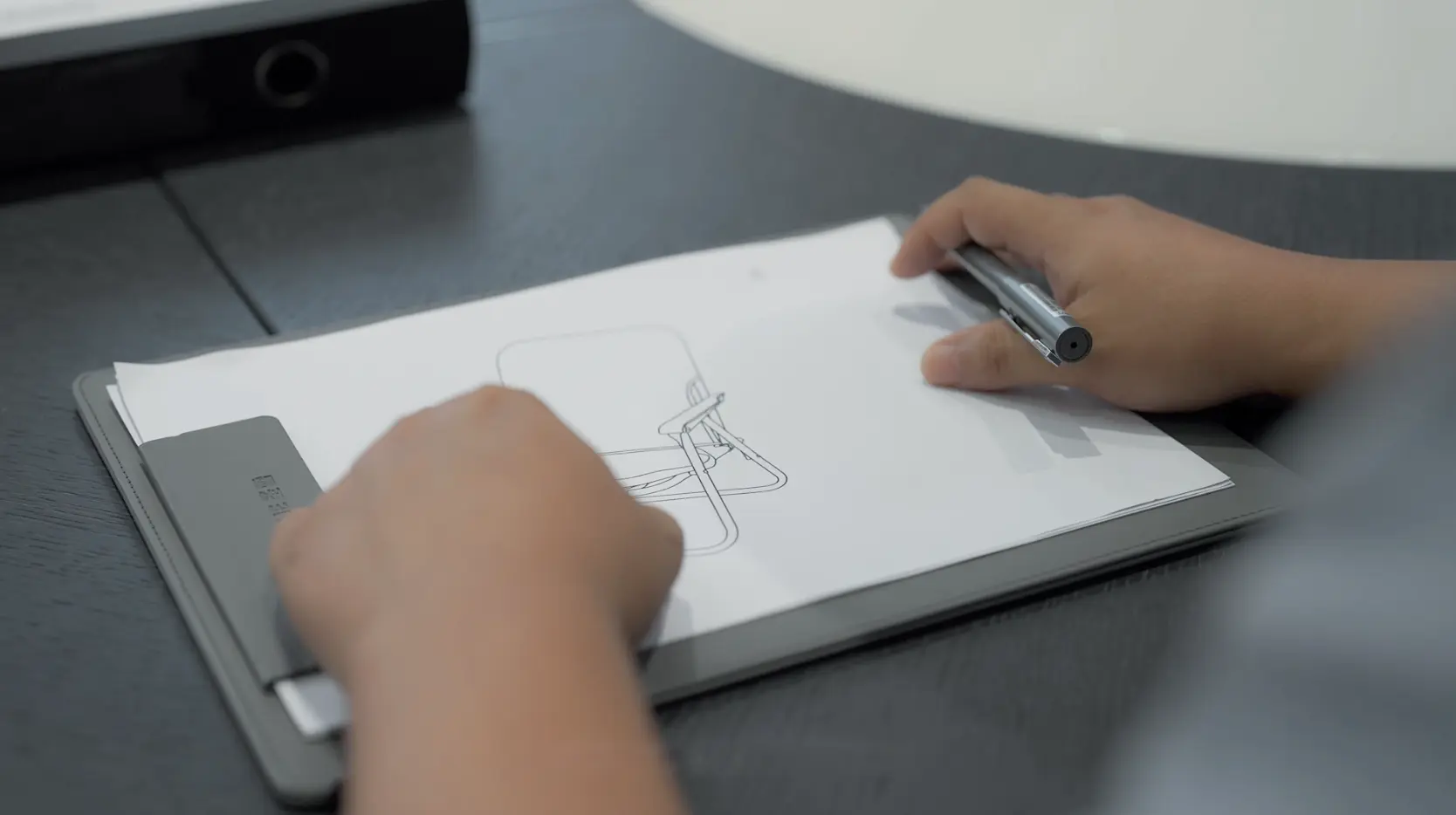
The key difference between OEM and ODM outdoor furniture is a distinction in design ownership that affects every downstream decision — from development cost and lead time to intellectual property control and product exclusivity.
Design ownership is the most fundamental factor. Under OEM, the brand owns 100% of the product’s intellectual property. Under ODM, the base design belongs to the manufacturer, and the buyer receives usage rights unless a separate exclusivity agreement is negotiated.
Development cost varies significantly. OEM projects require substantial upfront investment in design, prototyping, and tooling. ODM modifications involve considerably lower costs, typically limited to logo application, finish changes, and packaging adjustments.
Lead time favors ODM. ODM leverages pre-existing designs with established production setups, so delivery timelines are typically 30 to 60 days. OEM projects, requiring design validation and prototype iteration, usually span 45 to 90 days.
Minimum order quantities also differ. OEM orders generally require higher MOQs due to custom tooling and dedicated material sourcing. ODM manufacturers often support lower MOQs, making it easier for smaller brands to test the market.
Product exclusivity is built into OEM by default. In ODM, the same base product may be available to multiple buyers, meaning brands must rely on surface-level customization to differentiate.
How Do OEM and ODM Handle Intellectual Property Rights Differently?
OEM and ODM handle IP rights in fundamentally different ways. In OEM arrangements, brands should execute a Non-Disclosure Agreement before sharing any design files, and the manufacturing contract should explicitly assign all design IP to the buyer. In ODM arrangements, the underlying design IP remains with the manufacturer unless the buyer negotiates and pays for an exclusive purchase agreement. Brands entering ODM partnerships should clarify IP terms upfront to avoid situations where competitors acquire the same base product.
What Are the Advantages and Disadvantages of OEM Outdoor Furniture?
OEM outdoor furniture is a model that offers strong brand differentiation and full design control, but it requires higher upfront investment and longer development timelines.
Advantages include complete creative freedom over materials, dimensions, and aesthetics; product exclusivity that prevents competitors from selling identical items; stronger brand identity that supports premium pricing; and full IP ownership that builds long-term brand equity.
Disadvantages include higher R&D and tooling costs; longer development cycles with multiple prototype rounds; the need for a professional design team; higher MOQs that require greater capital commitment; and elevated risk if a new design fails to resonate with the market.
What Are the Advantages and Disadvantages of ODM Outdoor Furniture?
ODM outdoor furniture is a model that provides faster time-to-market and lower development costs by leveraging a manufacturer’s existing designs, but it offers limited exclusivity and less design freedom.
Advantages include dramatically shorter time-to-market; minimal upfront design investment; access to market-proven designs that reduce product failure risk; lower MOQs for easier market testing; and the ability to rapidly expand a product catalog without proportional R&D spending.
Disadvantages include limited design differentiation since other brands may sell visually similar products; potential margin pressure as competitors offer comparable products at lower prices; and IP constraints that may limit a brand’s ability to claim design ownership.
How Should Brands Choose Between OEM and ODM Outdoor Furniture?
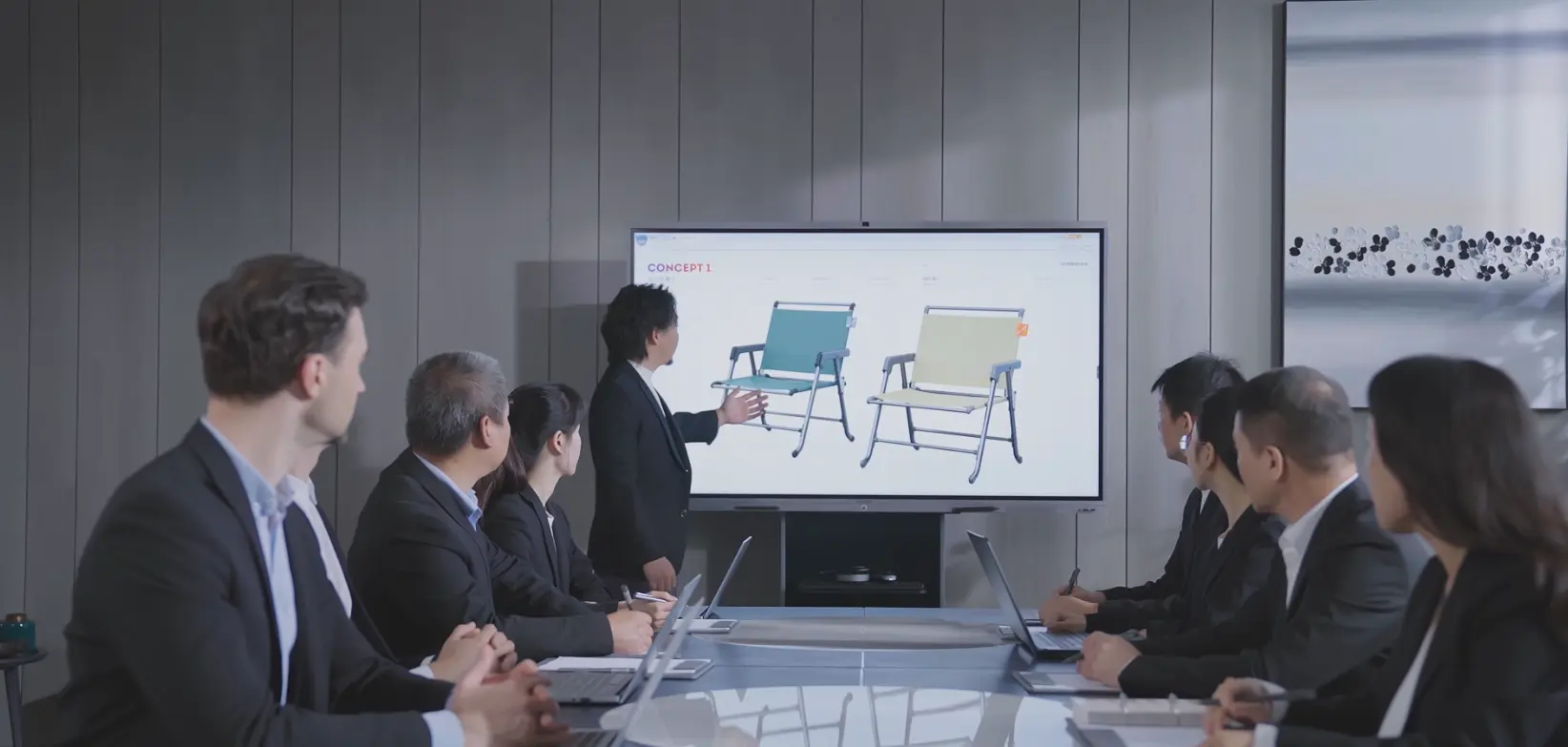
Brands should evaluate four factors when choosing between OEM and ODM: design capability, available budget, desired speed to market, and brand differentiation strategy.
Brands should choose OEM when they have an in-house design team or work with industrial designers; when product exclusivity is essential to market positioning; when targeting premium or hospitality markets where uniqueness commands higher margins; and when the budget and timeline allow for thorough product development.
Brands should choose ODM when entering the outdoor furniture market for the first time; when budgets are limited and speed is critical; when testing a new product category before committing to full-scale custom development; and when the company lacks dedicated product design resources.
Combining both models is a strategy many successful brands adopt. Core flagship products are developed through OEM to establish brand identity, while supplementary SKUs are sourced through ODM to fill out the product catalog quickly and cost-effectively.
How Can a Brand Transition from ODM to OEM as It Grows?
Many brands start with ODM to enter the market quickly and identify best-selling categories. As the brand matures, it can transition top-performing ODM products into OEM projects — redesigning the structure, upgrading materials, and securing exclusive IP. This phased approach minimizes early-stage risk while building toward a fully proprietary product line over time.
Does Manufacturing Location Affect OEM or ODM Outdoor Furniture Strategy?
Manufacturing location significantly impacts cost structure, lead time, compliance capabilities, and supply chain resilience for both OEM and ODM outdoor furniture.
China offers the world’s most mature outdoor furniture supply chain, with extensive material sourcing networks, large-scale production capacity, and deep experience serving global retail standards. A China-based manufacturing facility can typically handle high-volume OEM orders with complex specifications and tight quality tolerances.
Vietnam has emerged as a competitive alternative, offering tariff advantages under multiple free trade agreements, lower labor costs for certain product categories, and growing infrastructure investment. A Vietnam-based facility is particularly attractive for brands seeking supply chain diversification or preferential duty treatment.
Some manufacturers operate dual-factory strategies across both countries, allowing brands to split production for risk diversification and respond flexibly to changing trade policies.
What Should Brands Look for When Selecting an Outdoor Furniture Manufacturing Partner?
A reliable outdoor furniture manufacturing partner is a supplier that offers dual OEM and ODM capabilities, holds internationally recognized certifications such as FSC, BSCI, EN581, and ISO 9001/14001/45001, and maintains transparent quality control across all production stages.
Key evaluation criteria include production capacity relative to the brand’s order volume, sample delivery speed, after-sales responsiveness, willingness to support factory audits, and logistics capabilities including proximity to major shipping ports and experience coordinating global container shipments.
FAQs
Is ODM outdoor furniture lower quality than OEM?
Quality depends on the manufacturer’s standards and QC processes, not the business model itself. A reputable manufacturer applies the same quality control to both OEM and ODM production lines.
Can a brand switch from ODM to OEM over time?
Many brands begin with ODM for market entry and gradually develop proprietary OEM products as their design capabilities and budgets expand.
How long does it take to develop a new OEM outdoor furniture product?
OEM development typically takes 45 to 90 days from design submission to first production run, depending on product complexity and prototype iteration cycles.
What is the typical MOQ for OEM and ODM outdoor furniture orders?
OEM MOQs are generally higher due to custom tooling, while ODM MOQs tend to be lower and more flexible depending on the manufacturer’s policies.
Do brands need to sign an NDA before starting an OEM project?
An NDA is strongly recommended before sharing any proprietary design files, particularly in OEM engagements where IP protection is paramount.
Can a brand request an exclusive design under an ODM agreement?
Many manufacturers offer design exclusivity for ODM products at a premium. The terms, duration, and geographic scope should be clearly defined in the contract.
Want to Know More About Our Products?
View All Products NowAbout Author
Spring Nee
Spring Nee is the Sales & Marketing Director at Zhejiang Sunshine Leisure Products Co., Ltd. With nearly 20 years of experience in the outdoor leisure furniture industry, she specializes in camping chairs, beach chairs, folding outdoor seating, and OEM/ODM project communication. Spring also leads the company’s marketing content direction. Most of the articles published on this website are either written by Spring herself or reviewed by her before publication, ensuring that the content is practical, accurate, and based on real industry experience.