How to Get a Durable Camping Chair for $50–80 That Lasts 5+ Years

Jump to section
If you have ever watched a $25 camping chair buckle under you mid-cookout, you already know the frustration. The legs bow outward, the fabric tears along the seams, and suddenly you are sprawled on the ground wondering why you bothered. And if you have ever stared at a $300 premium camping chair in a retail store and thought, “That’s beautiful, but I’m not paying rent money for a folding chair,” you are not alone.
Between those two extremes lies a price range—roughly $50 to $80—where it is entirely possible to get a durable camping chair that handles five-plus years of campfires, tailgates, and backyard barbecues without falling apart or emptying your wallet. The catch? Most shoppers never find these chairs because the market is flooded with cheap disposables on one end and premium status symbols on the other.
This guide explains exactly what separates a durable camping chair from one that breaks after a single season, breaks down the real cost of each price tier, and shows how to identify the materials and construction that deliver long-term value. Whether you are a weekend camper, a tailgate regular, or a brand owner looking to manufacture reliable mid-range chairs, you will learn how to get—or build—the kind of durable camping chair that outdoor communities keep recommending to each other.
Why Do Cheap Camping Chairs Under $30 Break After One Season?
Budget camping chairs under $30 break quickly because they use four inferior components: 300D polyester fabric that degrades under UV exposure, thin-wall steel frames under 1.0 mm that bend under body weight, riveted joints that loosen with repeated folding, and hard plastic feet that crack on rough terrain.
- Fabric degradation — The 300-denier polyester used in most budget camping chairs offers minimal UV resistance. Sunlight breaks down the polymer chains, making the fabric brittle after just a few months of outdoor exposure. Add rain and moisture, and mold growth accelerates the decline. One season of regular use is often all it takes before the seat tears along the stitching.
- Frame bending — Low-carbon steel tubing with wall thickness under 1.0 mm cannot sustain repeated load cycles from a 180-pound adult, much less anyone heavier. The metal fatigues at stress points—usually where the legs meet the seat frame—and eventually bows outward until the chair becomes unstable or collapses entirely.
- Joint failure — Riveted joints are cheap to manufacture but they shear under lateral force. Every time you shift your weight, rock sideways, or fold and unfold the chair, the rivet holes elongate slightly until the joint becomes loose enough to collapse. This is the most common catastrophic failure mode in budget camping chairs.
- Foot-pad cracking — Hard plastic feet crack on rocky ground and slip on smooth surfaces. Without adequate support, the legs dig into soft soil, further stressing the frame geometry and accelerating structural failure.
- Ultra-low bill of materials — A $25 retail camping chair often has a bill-of-materials cost of just four to six dollars. At that price, the manufacturer is forced to cut corners on every single component. There is no room for UV-treated fabric, powder-coated steel, or stainless-steel hardware. The result is a product designed to survive the trip home from the store and not much more.
Are Expensive Camping Chairs Over $200 Actually Worth the Premium Price?

Premium camping chairs like the Yeti Trailhead deliver excellent durability through anodized aluminum frames and heavy-duty mesh rated to 500 pounds, but much of the price premium comes from brand marketing and retail distribution margins—not proportional material upgrades over a well-built $60–80 durable camping chair.
- Genuine quality strengths — High-end camping chairs use proprietary UV-resistant fabrics, cross-over frame designs that handle rough terrain, and weight capacities of 400–500 pounds that provide substantial safety margins. Reviewers consistently praise their stability, comfort, and build quality.
- Notable trade-offs at premium prices — Many $200–300 camping chairs weigh over 13 pounds, have no storage pockets, offer only a single awkward cupholder, and use plastic armrests that feel out of place on luxury products. For chairs at this price, the lack of basic conveniences is hard to ignore.
- Diminishing returns on durability — The material difference between a disposable camping chair and one that survives years of heavy use costs roughly eight to twelve dollars in manufacturing. Premium chairs spend far more than this on materials, but most of the additional cost goes to brand positioning, retail margins, and premium packaging—not structural improvements that extend usable lifespan.
- Cost-per-use reality — Most recreational campers do not reach 300-plus uses within a five-year window. The typical weekend camper who takes 20 to 40 trips a year will use a chair 100 to 200 times—a range where a well-constructed $65 durable camping chair delivers peak economic value without paying for durability you will never use.
What Materials Make a Durable Camping Chair Last 5+ Years?
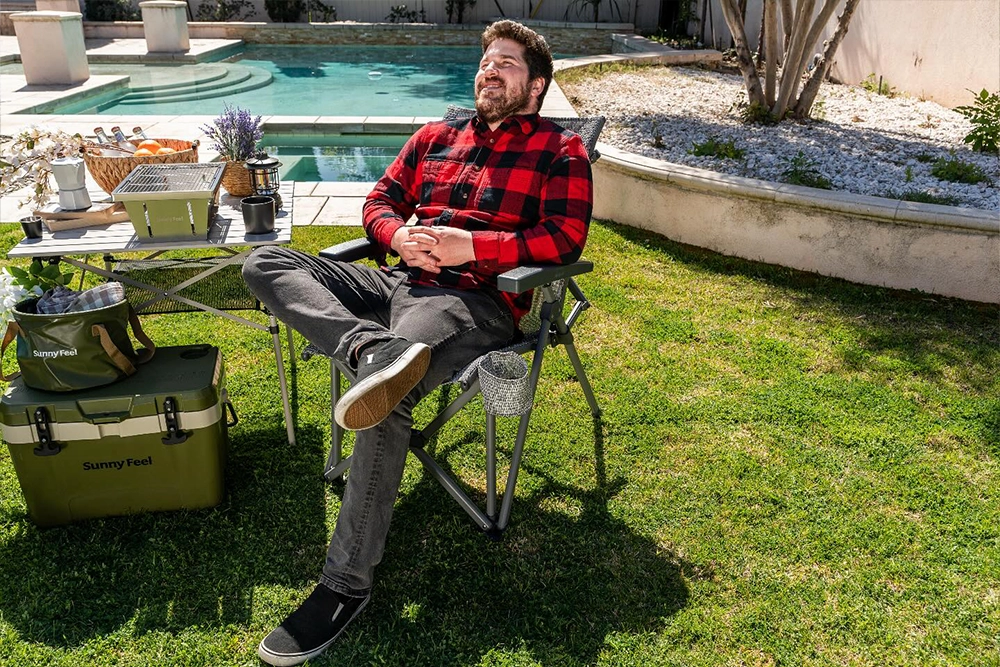
A durable camping chair built to last five-plus years needs four key material upgrades over budget models: 600D Oxford fabric with UV coating, powder-coated steel tubing with at least 1.2 mm wall thickness, bolt-locked or welded joints, and corrosion-resistant stainless-steel hardware—adding only eight to twelve dollars in total manufacturing cost.
What Fabric Specifications Should You Look for in a Durable Camping Chair?
The best fabric for a durable camping chair is 600D Oxford polyester with anti-UV coating, which extends useful life to five to eight years compared to one to two seasons for standard 300D polyester—at a cost increase of only two to three dollars per unit.
- Denier rating matters — Denier measures thread thickness. Standard budget chairs use 300D polyester that degrades quickly under sun exposure. Upgrading to 600D Oxford provides significantly better tear resistance and UV durability for minimal additional cost.
- UV coating is essential — Anti-UV coating prevents the polymer chains in polyester from breaking down under sunlight. Without this treatment, even high-denier fabric will become brittle and tear within two seasons of regular outdoor use.
- Textilene mesh for specialty applications — For beach and patio camping chairs, 480G to 600G Textilene mesh offers both breathability and weather resistance. This material handles moisture and heat better than solid fabric but costs slightly more.
- Reinforced stitching — Thread quality and stitch pattern matter as much as fabric quality. Double-stitched seams with UV-resistant thread prevent the most common failure point: fabric tearing along the seat edge where body weight concentrates.
What Frame Specifications Determine Camping Chair Durability?
A durable camping chair frame requires powder-coated steel tubing with a minimum wall thickness of 1.2 mm, which dramatically increases load-bearing capacity and fatigue resistance compared to budget chairs using sub-1.0 mm thin-wall steel—at an added cost of three to five dollars per unit.
- Wall thickness is the key variable — Thin-wall low-carbon steel under 1.0 mm wall thickness is the default for budget chairs and the reason so many of them bend under normal use. Stepping up to 1.2 mm or thicker provides the structural integrity needed for multi-year durability.
- Powder coating prevents corrosion — Raw steel rusts quickly in outdoor environments. Powder-coated finishes create a protective barrier that extends frame life significantly, especially in humid or coastal climates.
- Aluminum alloy for premium applications — Aerospace-grade aluminum alloy is lighter and naturally corrosion-resistant, but it pushes manufacturing costs higher. This material is typically reserved for ultralight backpacking or luxury camping chairs above the $80 price ceiling.
- Frame geometry affects stress distribution — How the frame tubes connect and distribute weight matters as much as the tube specifications. Well-engineered geometry spreads load across multiple contact points rather than concentrating stress at single joints.
What Joint and Hardware Specifications Prevent Camping Chair Failure?
Durable camping chair joints should use bolt-lock mechanisms or welded connections instead of rivets, combined with stainless-steel hardware instead of zinc-plated fasteners—eliminating the most common structural failure points for roughly two to three dollars additional cost.
- Bolt-lock joints versus rivets — Riveted joints are cheap to manufacture but shear under lateral force. Bolt-lock mechanisms or welded nodes add one to two dollars per unit but eliminate the joint loosening that causes most camping chair collapses.
- Stainless-steel hardware — Upgrading from zinc-plated hardware to stainless steel adds about one dollar per unit and prevents corrosion in humid or coastal environments. This small upgrade significantly extends the chair’s functional lifespan.
- Wide-base foot pads — Swapping hard plastic feet for wide-base polypropylene or rubber pads adds fifty cents and prevents sinking in soft ground while also improving stability on hard surfaces.
How Much Does a Durable Camping Chair Actually Cost Per Use?
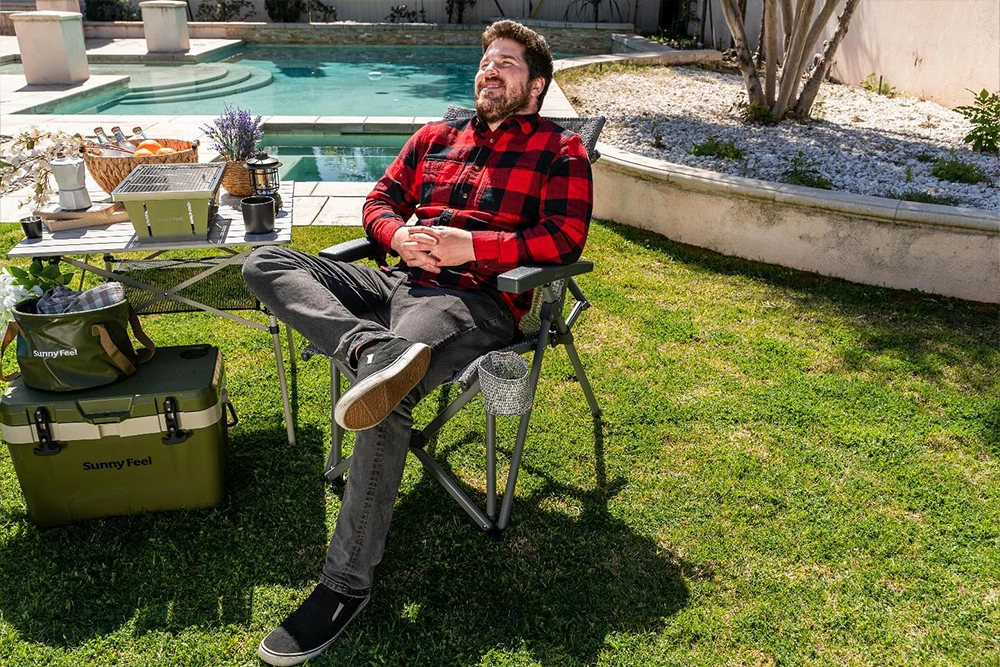
Cost per use equals purchase price divided by total uses over the chair’s lifespan. A $25 budget chair lasting 15–30 uses costs $0.83–$1.67 per use. A $65 durable camping chair lasting 150–250 uses costs $0.26–$0.43 per use. A $300 premium chair lasting 300–500 uses costs $0.60–$1.00 per use—making the mid-priced durable chair the best economic value.
- Budget tier economics — A $25 camping chair typically survives 15 to 30 uses before failure, creating a cost per use of $0.83 to $1.67. Over five years, a regular camper will likely purchase two to three replacement chairs, spending $50 to $75 total while experiencing multiple failures.
- Mid-range durable tier economics — A $65 durable camping chair built with proper materials lasts 150 to 250 uses, creating a cost per use of $0.26 to $0.43. This single chair covers five-plus years of regular camping without replacement, delivering the lowest total cost of ownership.
- Premium tier economics — A $300 premium camping chair may last 300 to 500 uses, but the cost per use remains $0.60 to $1.00—higher than the mid-range durable option. Unless you camp professionally or reach extremely high use counts, the premium investment does not pay back economically.
- Five-year total cost comparison — The budget approach costs $50–75 over five years with multiple failures and replacements. The mid-range durable approach costs $65 total with zero failures. The premium approach costs $300 total. The mid-range durable camping chair wins on both economics and user experience.
Which Types of Camping Chairs Offer the Best Durability Under $80?
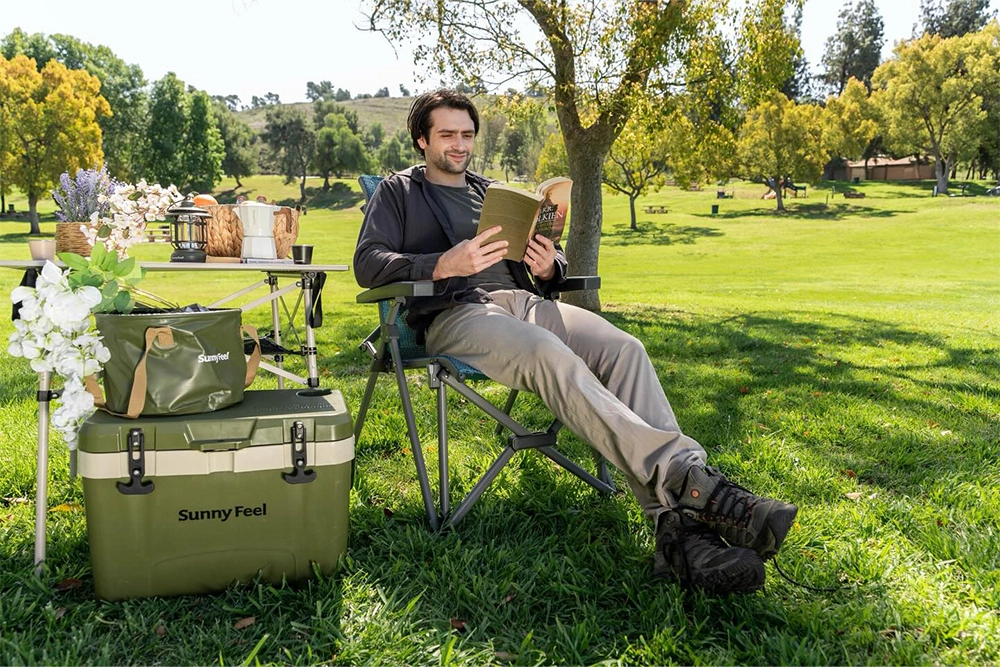
Classic quad-frame folding chairs and dual-lock mechanism chairs offer the best durability-to-price ratio under $80 because these designs distribute weight across four wide legs, use simple but robust folding mechanisms, and have the strongest long-term performance track record in outdoor communities.
- Quad-frame folding chairs — The traditional four-legged folding design is the safest choice for durability under $80. Weight distribution across four wide legs reduces stress on any single point, and the simple folding mechanism has fewer parts to fail. This design requires no market education—consumers immediately understand how to use it.
- Dual-lock mechanism chairs — Chairs with dual-lock folding systems offer very good durability with lighter weight than quad frames. The lock mechanism provides stability when deployed while allowing compact folding for transport. These work well for campers who prioritize portability alongside durability.
- Director-style chairs — Director chairs with side tables add perceived value and function well within the $80 ceiling. The taller seating position appeals to users who want easier entry and exit, though the narrower leg stance requires careful material selection to ensure stability.
- Low-profile chairs — Low camping chairs have grown popular with younger outdoor enthusiasts. These designs can achieve very good durability under $80 and appeal to a different aesthetic than traditional quad frames.
- Rocker and loveseat chairs — Rocker-style camping chairs and double-wide loveseats face tight margins under $80 due to their more complex mechanisms and larger material requirements. These designs can work at this price point but require careful cost engineering to maintain durability standards.
How Do You Choose Between Budget, Mid-Range, and Premium Camping Chairs?
Choosing the right camping chair tier requires evaluating four factors: your annual use frequency, weight and portability needs, tolerance for replacement hassle, and whether you prioritize lowest upfront cost or lowest total cost over time.
Assess Your Annual Camping Frequency
Your camping frequency determines which price tier delivers the best value for your specific usage pattern.
- Light use (under 20 trips per year) — If you camp occasionally, even a budget chair may survive multiple seasons. However, the frustration of mid-trip failures often makes the modest upgrade to mid-range durability worthwhile for peace of mind.
- Regular use (20–50 trips per year) — Regular campers will exhaust a budget chair within one to two seasons and should invest in a mid-range durable camping chair. The cost-per-use math strongly favors the $50–80 tier at this frequency.
- Heavy use (50+ trips per year) — Frequent campers, outdoor professionals, and event vendors may justify premium pricing if they will actually reach the 300+ use counts where premium durability provides value. For most users, mid-range remains optimal.
Evaluate Your Weight and Portability Requirements
Different camping scenarios demand different trade-offs between durability and portability.
- Car camping and tailgating — When you can drive to your campsite, chair weight matters less than durability and comfort. Heavier steel-frame chairs with maximum durability make sense for these applications.
- Backpacking and hiking — When you carry everything on your back, every ounce matters. Ultralight camping chairs require aluminum frames and lighter fabrics, which typically push prices above $80 or require durability compromises.
- Festival and event use — Chairs that travel frequently but do not need to be carried far benefit from durable construction with folding designs that protect the frame during transport.
Consider Your Tolerance for Replacement Hassle
Beyond economics, consider how much you value reliability and convenience.
- Prefer “buy once” simplicity — If you hate dealing with product failures and want gear that just works, invest in mid-range or premium durability. The peace of mind is worth the upfront cost.
- Comfortable with replacement cycles — If you do not mind occasionally buying new chairs and prefer minimizing upfront spending, budget options may suit your temperament despite the higher long-term cost.
Calculate Total Cost of Ownership
Make the economic comparison explicit before purchasing.
- Budget approach — Expect to spend $50–75 over five years on multiple chair purchases, plus the inconvenience of failures and shopping time.
- Mid-range durable approach — Spend $50–80 once and enjoy five-plus years of reliable use with no replacement hassle.
- Premium approach — Spend $200–300 once for maximum durability, but recognize that most users will not reach the use counts that justify this investment economically.
How Do You Identify a Reliable Camping Chair Manufacturer or OEM Partner?
Brands should evaluate camping chair OEM partners on five criteria: Tier-1 retailer experience proving factory audit compliance, international certifications including BSCI, ISO, and EN581, in-house R&D capabilities with patents, flexible minimum order quantities for trial orders, and multi-country manufacturing to mitigate tariff and supply chain risk.
Verify Tier-1 Retailer References
Factory relationships with major retailers provide the strongest quality validation available.
- Why retailer references matter — Has the factory supplied Walmart, Costco, Target, or equivalent retailers? These companies run the most rigorous factory audits in consumer goods. Passing a Walmart audit is stronger validation than any self-reported quality claim.
- Audit compliance indicates consistency — Major retailers audit not just product quality but manufacturing processes, worker safety, environmental practices, and supply chain documentation. A factory that passes these audits has demonstrated systematic quality control.
Confirm Essential Certifications
Product and factory certifications are non-negotiable for serious market entry.
- Product certifications to require — EN581 for European structural standards, Prop 65 for California chemical compliance, and EN71 for child safety if applicable. These certifications prove the product meets established safety and durability benchmarks.
- Factory certifications to verify — BSCI for social compliance, ISO 9001 for quality management systems, and ISO 14001 for environmental standards. These certifications indicate professional manufacturing operations rather than informal assembly shops.
Evaluate In-House R&D Capabilities
A factory with genuine design capability can help you innovate rather than just replicate existing products.
- Design team presence — Does the factory have its own design team? How many patents does it hold? Can it do ODM—taking your concept from sketch to finished product—or is it purely assembly?
- Innovation track record — How many new products does the factory develop annually? A manufacturer that consistently creates new designs understands materials, mechanisms, and market trends at a deeper level than pure contract assemblers.
Assess MOQ Flexibility
Flexible minimum order quantities let new brands validate market demand before committing large capital.
- Trial order options — Can you start with 500 units? Can you begin with stock models carrying your logo? Rigid high-MOQ requirements force brands to over-commit before proving product-market fit.
- Scaling pathway — Does the factory support growth from trial orders to full production runs? A good OEM partner helps brands start small and scale as demand proves out.
Confirm Multi-Base Manufacturing
Dual-country manufacturing provides critical protection against tariff volatility and supply chain disruptions.
- Tariff hedging — With ongoing tariff changes between the US and China, a factory operating in both China and Vietnam gives brands flexibility to shift production based on landed cost calculations.
- Supply chain resilience — Dual-base operations protect delivery timelines during geopolitical disruptions, natural disasters, or capacity constraints at any single facility.
How Does China Plus Vietnam Dual Manufacturing Reduce Camping Chair Costs?
Dual-base manufacturing in China and Vietnam allows OEMs to shift production between countries based on tariff changes, potentially reducing landed costs by 10–25% for US-bound shipments while maintaining consistent product quality through unified quality control across both facilities.
- Tariff arbitrage opportunity — US duties on Chinese-manufactured goods have fluctuated significantly in recent years. Brands sourcing exclusively from China carry concentrated tariff risk. A single duty increase can wipe out product margins overnight.
- Vietnam as alternative origin — Vietnam-origin goods often face lower US import duties than China-origin goods for the same product category. Shifting production to Vietnam for tariff-sensitive markets can significantly improve landed cost economics.
- Unified quality standards — The key requirement is that both facilities operate under identical quality protocols. Incoming material inspection, in-process checks, load testing, and outgoing controls must be consistent regardless of which country produces a given batch.
- Capacity flexibility — Dual-base operations also provide surge capacity. If demand spikes or one facility faces constraints, production can shift to maintain delivery schedules without quality compromises.
What Does the Camping Chair OEM Process Look Like from Concept to Shipping?
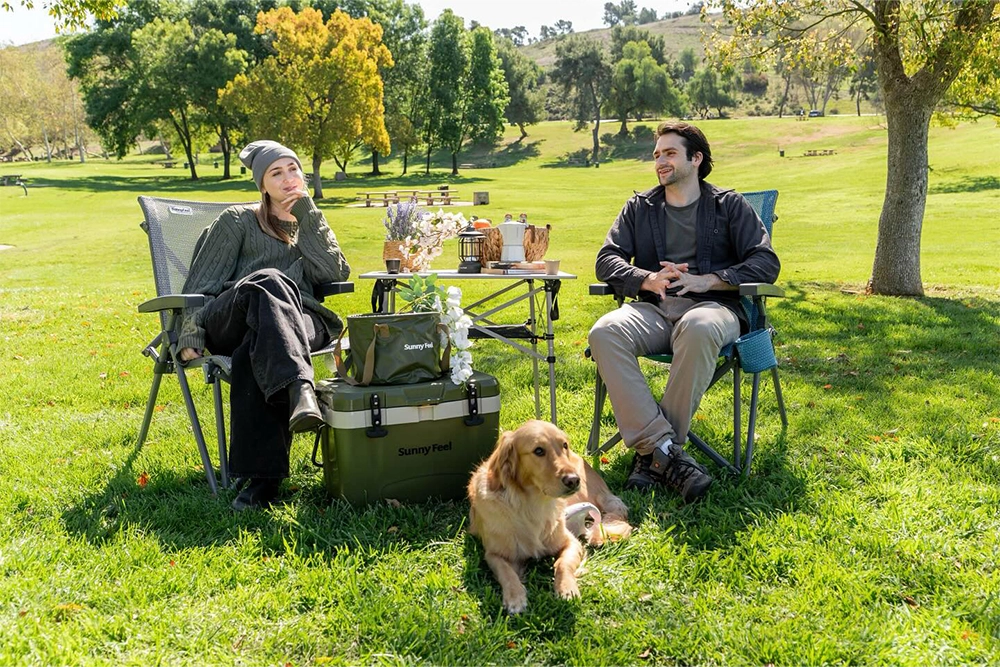
A standard OEM camping chair project takes 10–16 weeks from concept to container: requirements confirmation in weeks 1–2, design and sampling in weeks 3–6, testing and certification in weeks 5–8, trial production in weeks 8–10, and mass production with QC inspection in weeks 10–16.
- Requirements and RFQ phase (weeks 1–2) — Define target chair type, retail price, annual volume, and primary market. Submit detailed requirements to receive a specification sheet and confirmed target pricing. Professional OEMs respond within 48 hours.
- Design and sampling phase (weeks 3–6) — Receive 3D renders and physical samples for evaluation. Stock model customization typically takes 4–8 weeks. Full ODM development from original concept takes 12–16 weeks.
- Testing and certification phase (weeks 5–8) — Complete EN581 load testing, Prop 65 chemical compliance, salt spray corrosion testing, and other required certifications. Factories with in-house testing laboratories can run this phase in parallel with sampling.
- Trial production phase (weeks 8–10) — Produce a small batch to lock manufacturing processes and identify any issues before scale-up. This is the critical quality gate that prevents discovering problems after thousands of units have been manufactured.
- Mass production and shipping phase (weeks 10–16) — Execute bulk production with systematic quality control. Conduct AQL inspection before shipment. Arrange FOB or CIF logistics to destination.
- Common mistakes to avoid — Skipping the sampling phase, relying solely on factory self-testing without independent verification, comparing only FOB prices while ignoring total landed cost, and setting MOQ requirements so rigidly that good factories decline the project.
How Should Brands Position a $60 Durable Camping Chair Against Budget and Premium Competitors?
Mid-range camping chair brands should build positioning around verifiable durability—publishing material specifications, sharing factory load-test footage, and stating explicit lifespan expectations—to differentiate clearly from budget chairs’ vague claims and premium brands’ lifestyle-driven pricing.
- Compete downward on value, not price — Against $25 big-box store chairs, the message is simple: one $65 chair that lasts five years versus three $25 chairs that each break after one season. That is $65 versus $75, with less waste and less frustration. The cost-per-use framework makes this argument quantifiable.
- Compete upward on transparency, not status — Against $300 premium chairs, emphasize value engineering. A well-constructed $65 chair delivers roughly 90% of the durability at about 22% of the price. Prove this through transparency about material specifications that premium brands often do not disclose publicly.
- Demonstrate durability visually — The most effective marketing content for mid-range durable camping chairs is demonstrative rather than aspirational: load-test video footage from certified labs, close-up material comparison images, and long-term use documentation showing the chair after 50, 100, and 200 uses.
- Engage durability-focused communities — Outdoor forums and communities dedicated to buy-it-for-life products provide organic discovery for genuinely durable camping chairs. Authentic community engagement builds credibility that advertising cannot replicate.
Why Do Global Retailers Trust Sunshine Outdoor for Camping Chair Manufacturing?
Global retailers trust Sunshine Outdoor because the company combines 21 years of manufacturing experience, dual production facilities in China and Vietnam, active OEM relationships with Walmart, Target, Costco, and other major retailers, comprehensive ISO and BSCI certifications, and in-house R&D capabilities that support both OEM customization and full ODM product development.
- Scale and experience — Founded in 2004 and headquartered in Wuyi, Zhejiang, Sunshine operates with over 2,000 employees across dual production bases in China and Vietnam. Monthly capacity exceeds 2.2 million units in China, with Vietnam expanding to 600,000 units monthly by 2026.
- Tier-1 retailer validation — Active supply relationships with Walmart, Target, Costco, Carrefour, ALDI, JYSK, and other major retailers prove that Sunshine passes the most rigorous factory audits in consumer goods manufacturing.
- Comprehensive certifications — The company holds ISO 9001, ISO 14001, and ISO 45001 factory certifications alongside BSCI, FSC, GRS, and REACH compliance. Product testing covers EN581 structural standards, California Prop 65 chemical requirements, and salt-spray corrosion testing.
- In-house R&D and innovation — Dedicated R&D teams across offices in Shanghai, Hangzhou, the United States, and Germany develop hundreds of new SKUs annually. This positions Sunshine as a product development partner rather than just an assembly contractor.
- Workforce stability — Most of Sunshine’s production staff have been with the company for many years, which translates directly into consistent assembly quality and prevents the random defects that plague factories with high turnover.
- Dual-base tariff flexibility — The China-plus-Vietnam manufacturing footprint gives brand partners flexibility to optimize landed costs based on current tariff structures while maintaining consistent quality standards across both facilities.
Is a $50–80 Durable Camping Chair the Right Choice for Your Needs?
A $50–80 durable camping chair is the right choice for most recreational campers, tailgaters, and backyard users who want reliable five-year performance without premium pricing—delivering the lowest cost per use of any price tier while eliminating the frustration of repeated budget chair failures.
The camping chair market does not reward the most expensive product or the cheapest one. It rewards the product that delivers consistent durability at a price consumers feel good about paying. The material upgrades that transform a disposable chair into a five-year workhorse cost only eight to twelve dollars in manufacturing—a gap that is entirely achievable within the $50–80 retail range.
For individual buyers, the decision is straightforward: invest modestly in verified durability and stop the cycle of buying replacement chairs every season. For brands looking to serve this market, the opportunity is equally clear: partner with a manufacturer who can execute the material upgrades consistently at scale, and position your product around transparent, verifiable quality claims that differentiate from both budget disposables and overpriced premiums.
Ready to explore durable camping chair options? Browse Sunshine Outdoor’s camping chair catalog for OEM and wholesale solutions, or request a quote to discuss custom manufacturing for your brand.
FAQs
What Weight Capacity Should a Durable Camping Chair Have?
A durable camping chair should have a minimum weight capacity of 300 pounds for general use, with 400–500 pound ratings recommended for users who want extra safety margin or expect heavier users. Weight capacity reflects both frame strength and fabric tensile limits.
How Can You Tell If a Camping Chair Will Last Before Buying?
Check four specifications before purchasing: fabric denier rating (look for 600D or higher), frame wall thickness (1.2 mm minimum for steel), joint construction (bolt-lock or welded, not riveted), and hardware material (stainless steel, not zinc-plated). If the seller does not disclose these specs, assume budget-tier materials.
Are Aluminum or Steel Frames Better for Durable Camping Chairs?
Steel frames with adequate wall thickness (1.2 mm+) and powder coating offer excellent durability at lower cost. Aluminum frames are lighter and naturally corrosion-resistant but cost more. For durability under $80, powder-coated steel typically provides better value.
How Long Should a Durable Camping Chair Last?
A properly constructed camping chair with 600D fabric, adequate frame thickness, and quality joints should last 150–250 uses over five to eight years of typical recreational camping. This assumes normal use patterns of 20–50 camping trips annually.
Can You Repair a Damaged Camping Chair or Should You Replace It?
Minor fabric tears can sometimes be patched, and loose hardware can be tightened. However, bent frames, torn seat seams, and failed joints typically indicate structural compromise that makes repair impractical. A chair showing these symptoms should be replaced for safety.
What Is the Best Camping Chair Type for Heavy Users Over 250 Pounds?
Heavy users should prioritize quad-frame designs with 400+ pound weight ratings, reinforced joints, and wide-base feet that prevent sinking. Avoid ultralight chairs and check that the manufacturer specifically rates the chair for higher weight capacities rather than assuming standard chairs will suffice.
Want to Know More About Our Products?
View All Products NowAbout Author
Spring Nee
Spring Nee is the Sales & Marketing Director at Zhejiang Sunshine Leisure Products Co., Ltd. With nearly 20 years of experience in the outdoor leisure furniture industry, she specializes in camping chairs, beach chairs, folding outdoor seating, and OEM/ODM project communication. Spring also leads the company’s marketing content direction. Most of the articles published on this website are either written by Spring herself or reviewed by her before publication, ensuring that the content is practical, accurate, and based on real industry experience.