Heavy Duty Camp Chair for Big Guys: Why 400 lbs Capacity Is the Next High-Growth OEM Opportunity

Jump to section
A 280 lb camper sits down in a folding chair rated for 250 lbs. The frame groans. The fabric stretches. Six camping trips later, the rear leg tube bends permanently inward, and the chair becomes a liability instead of a seat. This scenario repeats millions of times every year across campgrounds, tailgate parties, fishing spots, and backyard gatherings — and each failure represents a lost customer, a negative review, and a missed opportunity for brands that could have sold a chair actually engineered for the load.
The plus-size outdoor seating market is one of the most underserved segments in the camping industry. Over 42% of American adults have a BMI of 30 or above, yet the vast majority of camp chairs on the market are designed for users weighing 150–200 lbs. When heavier users purchase these standard chairs, they experience premature failure: bent tubes, torn fabric, collapsed joints, and the frustration of products that simply do not work for their body type. The result is a consumer segment actively searching for solutions — and willing to pay premium prices for chairs that deliver genuine structural reliability.
For brand owners and retailers, this gap between market demand and product availability represents a compelling growth opportunity. Users above 250 lbs who find a camp chair that genuinely works become fiercely loyal customers and vocal advocates in online communities. They accept higher price points because they have already learned that cheap chairs cost more in the long run. And they face minimal competition, because most outdoor furniture manufacturers lack the engineering capability to produce chairs that meet true heavy duty specifications.
This guide explains what separates a genuine 400 lbs capacity heavy duty camp chair from a standard chair with an inflated weight rating. You will learn the specific tubing dimensions, material grades, seat measurements, and testing protocols that define structural reliability for plus-size users — and how to evaluate OEM suppliers who can deliver these specifications at production scale. Whether you are developing a dedicated heavy duty product line or adding reinforced SKUs to an existing catalog, the engineering standards in this guide will help you capture a loyal customer segment that most competitors have overlooked.
What Makes a Heavy Duty Camp Chair Different from a Standard Folding Camp Chair?
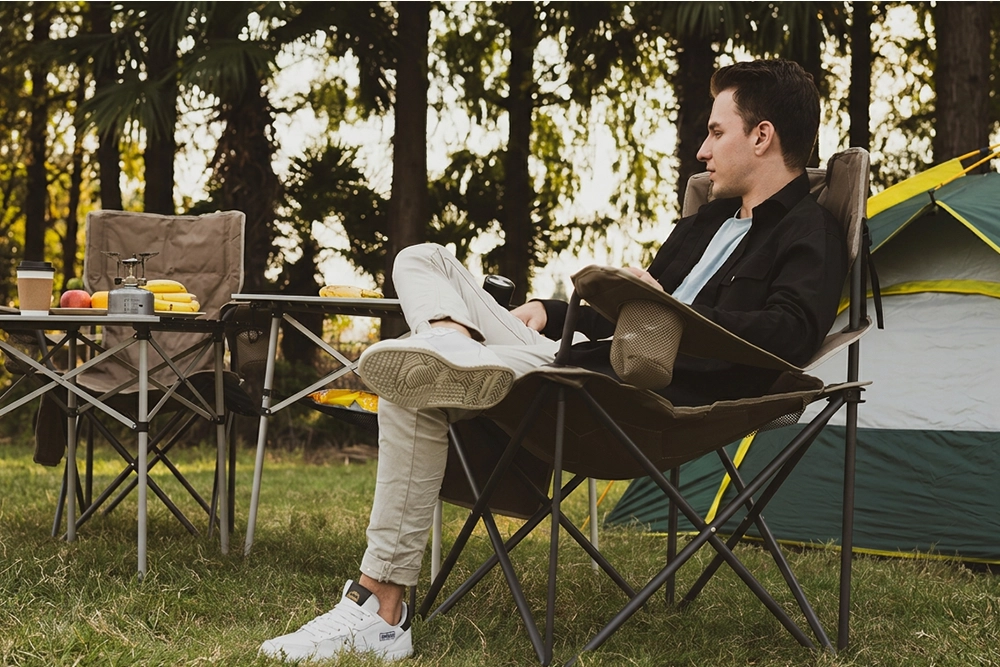
A heavy duty camp chair differs from a standard folding camp chair in four engineering specifications: a verified 400 lbs dynamic load capacity, steel tubing with a minimum 22 mm outer diameter and 1.2 mm wall thickness, a seat width of 22 inches or more, and integrated lumbar support for extended outdoor sitting.
Most camping chairs on the market are designed for an average body frame of 150–200 lbs. This design assumption leaves millions of plus-size and tall consumers without a reliable seating option. A chair rated at 250 lbs may hold a 180 lb person through several seasons, but a 280 lb user generates significantly more stress on the frame joints, fabric seams, and folding mechanism every time they sit down, shift position, or stand up. The result is premature failure — bent tubes, torn fabric, and collapsed joints that turn a relaxing campsite into a frustrating and potentially dangerous situation.
A true heavy duty camp chair solves this problem by engineering every component for higher loads: thicker steel tubing, wider seat dimensions, reinforced stitching, and a frame geometry that distributes weight across more contact points. This guide explains exactly what specifications separate a genuine heavy duty camp chair from a standard chair with an inflated weight rating — and why this product segment represents a compelling growth opportunity for brand owners and retailers.
At Sunshine Outdoor, we have served 50+ global brands including Walmart, Sam’s, Costco, and Coleman as an OEM/ODM outdoor furniture manufacturer for over 21 years. Our camping chair production line covers the full engineering chain from tube selection and frame design to load testing and mass production — including the heavy duty segment that most generic manufacturers cannot deliver reliably.
Why Is the Plus-Size Camp Chair Market a High-Growth Opportunity for Brand Owners?
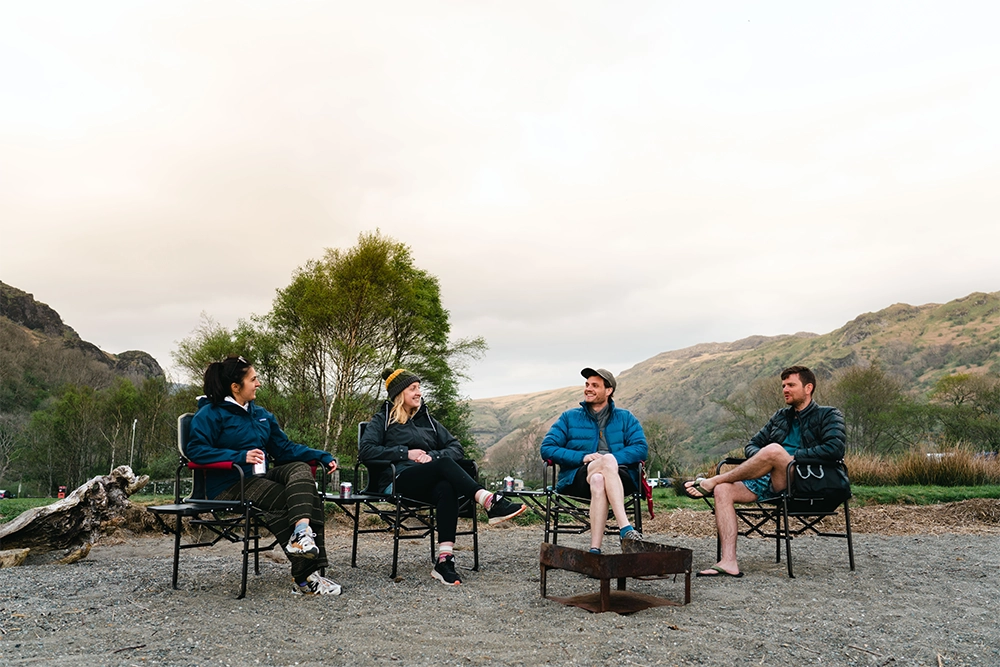
The plus-size camp chair market is a high-growth opportunity because it serves a consumer segment with high brand loyalty, low price sensitivity, and minimal competition. Users above 250 lbs who find a structurally reliable chair become repeat buyers and vocal brand advocates in online communities.
The business case for heavy duty camp chairs rests on three market dynamics that most outdoor furniture categories do not share.
First, customer loyalty in this segment is exceptionally high. Plus-size campers who find a chair that genuinely works — one that does not bend, does not pinch their thighs, and does not collapse after two trips — become fiercely loyal to that brand. Reddit camping communities and Facebook groups dedicated to plus-size outdoor recreation show a consistent pattern: a single positive recommendation from a trusted user generates 5–10 direct purchase inquiries. This word-of-mouth multiplier is significantly higher than in mainstream camp chair categories where products are largely interchangeable.
Second, price sensitivity is low. A user who has destroyed three $30 chairs in one season is willing to pay $80–$150 for a chair that lasts three years. The economic logic is obvious to the buyer, which means brand owners can maintain healthy margins on heavy duty SKUs without competing on price alone.
Third, competition is minimal. Most major outdoor brands have not developed dedicated heavy duty product lines because the engineering requirements are higher — thicker tubing, new frame molds, stricter testing protocols. This creates a barrier to entry that also functions as a barrier to competition. Brand owners who invest in proper engineering now can establish category ownership before larger players enter the space.
The addressable market is substantial. According to CDC data, over 42% of American adults have a BMI of 30 or above. This is not a niche demographic — it represents roughly 110 million potential consumers in the United States alone, many of whom actively participate in camping, fishing, tailgating, and backyard recreation.
Sunshine’s OEM/ODM solutions help brand owners cross the engineering threshold and enter this market quickly. With four global R&D centers (Shanghai, Zhejiang, US, and Europe) and 80+ new product launches per year — over 50% patented — we have the design velocity to help partners develop and test heavy duty prototypes within weeks, not months.
Why Do Standard Camp Chairs Fail for Users Above 250 lbs?
Standard camp chairs fail for users above 250 lbs because they use thin-walled 16–19 mm aluminum tubes, offer 17–19 inch seat widths, and carry static weight ratings of 200–250 lbs that do not account for the dynamic impact force of 1.5–2x body weight generated during normal sitting movements.
The core problem is a gap between the rated capacity printed on the packaging and the forces that the chair actually experiences during use. When a 280 lb person sits down into a camp chair, the momentary force on the frame can reach 420–560 lbs due to the dynamic impact multiplier of 1.5–2x body weight. A chair rated at 250 lbs under static conditions was never designed to absorb that kind of shock. The weakest points — cross-joint rivets, leg tube bends, and fabric attachment seams — take the brunt of that force and degrade rapidly.
Plus-size users consistently report three categories of failure:
1. Tube bending. The main support legs or armrest tubes deform after repeated use because the wall thickness (typically 0.8–1.0 mm on standard chairs) is too thin to resist lateral force from a heavier load. Thin-walled aluminum tubes in the 16–19 mm diameter range have insufficient bending resistance at the stress concentrations created by frame bend points.
2. Fabric tearing. Standard 300D–420D polyester stretches and frays at the seam points where stress concentrates, especially along the front seat edge where the user’s thighs press downward. Single-seam stitching fails under sustained tension that exceeds the thread’s tensile capacity.
3. Joint failure. The riveted or bolted connections at the folding mechanism wear out because the fasteners were sized for lower loads. Each sit-stand cycle creates micro-movement at the joint that gradually enlarges the rivet hole, leading to play, wobble, and eventual structural collapse.
Beyond structural failure, standard chairs create an immediate comfort problem. A seat width of 17–19 inches forces a plus-size user’s thighs against the metal armrest frame, restricting blood circulation and creating pressure marks. The seat depth of 15–17 inches does not provide enough thigh support for taller individuals, causing the user to slide forward and increasing strain on the lower back.
Reddit communities dedicated to camping and outdoor recreation feature numerous threads from plus-size users describing these exact problems. Users report chairs lasting only one or two trips before showing visible frame deformation. Others describe the embarrassment of a chair collapsing at a campsite in front of friends and family. These are not isolated complaints — they reflect a systematic design gap in the outdoor furniture industry. For brand owners, this gap is an opportunity: users are actively searching for solutions. Keywords like “best camp chair for big guys” and “heavy duty camp chair 400 lbs” show sustained and growing search volume.
What Weight Capacity Should a Heavy Duty Camp Chair Be Rated For?
A heavy duty camp chair should be rated for a minimum of 400 lbs static weight capacity to safely support users weighing 250–300 lbs. The 400 lbs threshold accounts for the 1.5x dynamic impact multiplier generated during sitting, standing, and shifting movements in outdoor use conditions.
Weight capacity ratings on camp chairs refer to static load — the maximum weight the chair can hold when the user is sitting perfectly still. However, the act of sitting down, standing up, leaning back, and shifting position generates dynamic forces that temporarily exceed the user’s body weight. Engineering standards for seating design typically apply a safety factor of 1.5x to 2x to account for these dynamic loads.
This means a 280 lb user needs a chair rated for at least 420 lbs under static conditions to have a reasonable safety margin during normal use. A 300 lb user needs a chair rated for 450 lbs or higher. Rounding to the commonly available 400 lbs rating provides a practical minimum threshold that covers the majority of plus-size users while allowing margin for dynamic forces.
The problem intensifies because many manufacturers test weight capacity using methods that do not simulate real-world conditions. A static load test places a uniform weight on the seat surface and holds it for a set duration — typically 5–10 minutes. This does not replicate the impact spike that occurs when someone drops into the chair from a standing position, nor does it test the lateral forces generated by leaning to one side to reach for a cooler or adjust a fishing rod.
Reputable heavy duty camp chair manufacturers test for cyclic fatigue in addition to static load. Cyclic fatigue testing applies the rated load repeatedly — 5,000 to 10,000 cycles — to simulate months or years of regular use. This test reveals weaknesses in joints, welds, and fabric that a single static load test cannot detect. When evaluating a camp chair supplier, brand owners should ask whether the rated capacity reflects static-only testing or includes cyclic fatigue and impact validation.
Sunshine’s testing protocols align with EN581 structural integrity standards, which include static load holds, cyclic fatigue, and impact testing. Our unified quality system across both factory sites (China and Vietnam) ensures that every production batch meets the same certified load specifications.
What Steel Tubing Specifications Define a Genuine Heavy Duty Camp Chair?
A genuine heavy duty camp chair requires steel tubing with a minimum outer diameter of 22–25 mm, wall thickness of 1.2 mm or greater, and a material grade of Q345 or equivalent structural steel with yield strength of 345 MPa or higher to resist permanent bending under repeated high-load use.
The tubing is the structural skeleton of a folding camp chair. Every force — body weight, dynamic impact, lateral lean, wind load — passes through the tube frame before reaching the ground. The tube’s ability to resist bending and buckling depends on three measurable properties: outer diameter, wall thickness, and material grade.
Outer diameter determines the tube’s moment of inertia — its resistance to bending. A 25 mm diameter tube has approximately 73% more bending resistance than a 19 mm tube of the same wall thickness, based on the engineering formula for second moment of area of a circular cross-section. This is not a marginal improvement. It is the difference between a frame that holds shape under 400 lbs and one that permanently deforms.
Wall thickness determines how much material is available to resist stress at the tube surface. Standard camp chairs use wall thicknesses of 0.8–1.0 mm to minimize weight and cost. Heavy duty chairs require 1.2 mm or thicker walls to prevent localized buckling at bend points and joint connections where stress concentrates. The bend radius at the leg pivot and the cross-tube junction are the most common failure points, and thicker walls provide a direct increase in resistance at these locations.
Material grade affects yield strength — the force level at which the tube begins to permanently deform. Mild steel (Q195 or Q235 grade) has a yield strength of 195–235 MPa. High-carbon steel or structural-grade steel (Q345 or equivalent) offers yield strength of 345 MPa or higher, meaning the tube can absorb 47–77% more force before permanent bending begins. The steel grade is often the hidden variable that separates a genuine heavy duty chair from a standard chair with thicker-looking tubes but inferior material.
As a specialized outdoor folding chair manufacturer, Sunshine controls the full process from tube selection and bending to welding and surface treatment. Our powder-coated finishes add corrosion resistance for outdoor use while maintaining the tube’s structural integrity. We can customize tube diameter, wall thickness, and steel grade to match the target load rating and price point of each brand partner’s product specification.
What Seat Dimensions Does a Plus-Size Camp Chair Require?
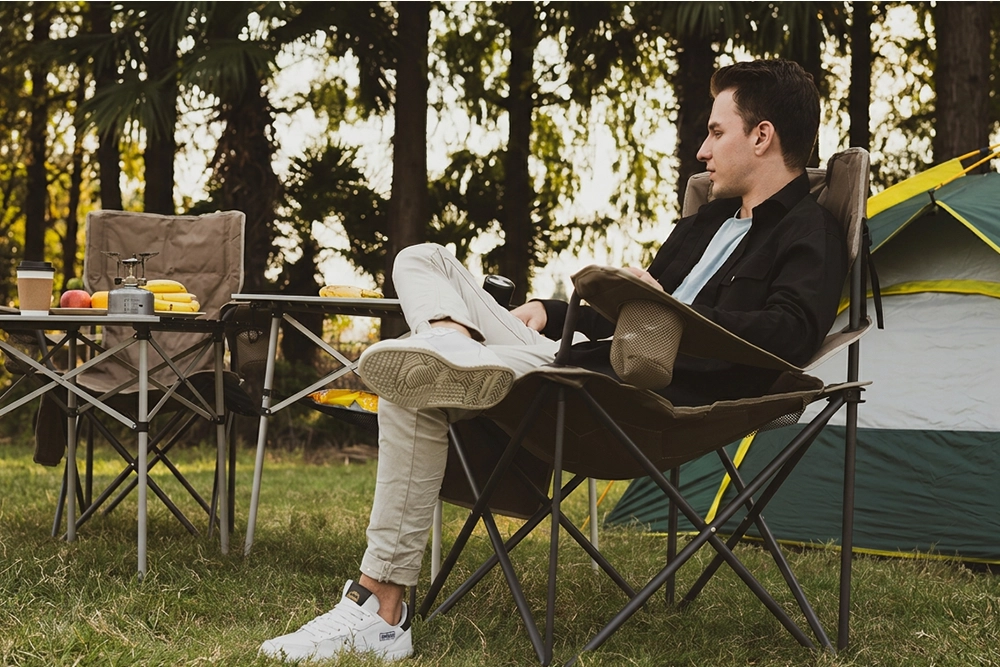
A plus-size camp chair requires a seat width of 22 inches or more, a seat depth of 20 inches or more, and a seat height of 18–20 inches. Standard camp chairs with 17–19 inch seat widths compress the user’s thighs against metal armrest frames, causing discomfort and restricted blood circulation during outdoor use.
Seat width is the horizontal distance between the inner edges of the armrest tubes at seat level. This measurement directly determines whether a user’s hips and thighs fit comfortably within the seating area. The average hip width for adult males in the 95th percentile is approximately 16.5 inches, but clothing, winter layers, and natural seated spread add 3–5 inches to the effective width needed for comfortable seating. A 22-inch minimum seat width provides clearance for users up to the 99th percentile in hip width while wearing typical outdoor clothing.
Seat depth is the horizontal distance from the front edge of the seat to the backrest. Standard chairs offer 15–17 inches of seat depth, which is adequate for users with a thigh length under 20 inches. Taller users with longer femurs need 20 inches or more of seat depth to prevent the front edge of the seat from pressing into the back of the knee, which restricts blood flow and causes numbness during extended sitting.
Seat height — the vertical distance from the ground to the top of the seat surface — is equally important for big and tall users. A seat height of 18–20 inches is recommended for users over 6 feet tall. Lower seat heights force the knees above hip level, which compresses the abdomen and increases lower back strain. Higher seat heights also make it significantly easier to stand up, reducing the explosive force required to push out of the chair and the corresponding stress on frame joints.
The armrest width — the distance between the outer edges of the armrests — should be at least 24 inches for plus-size users. Narrow armrests create pinch points on the outer thigh and hip, which are not only uncomfortable but can cause bruising during a multi-day camping trip.
Designing a plus-size chair is not simply a matter of “scaling up” a standard model. The frame geometry must be redesigned to maintain center-of-gravity stability at the wider dimensions, and the folding mechanism must accommodate the larger footprint without adding excessive weight. Sunshine’s four global R&D centers and engineering team — which launches 80+ new products per year — have the prototyping speed and structural analysis capability to develop correctly proportioned heavy duty frames from the ground up, not stretched-out versions of standard designs.
Why Does Lumbar Support Matter in a Heavy Duty Camp Chair?
Lumbar support matters in a heavy duty camp chair because users above 250 lbs generate greater compressive force on the L4-L5 vertebrae during seated posture. A high backrest of 30 inches or taller with integrated lumbar contouring distributes spinal load and reduces lower back fatigue during extended outdoor sitting sessions.
The lumbar spine (L1–L5 vertebrae) carries the majority of the upper body’s weight during seated posture. When a person sits without lumbar support, the natural inward curve of the lower back (lordosis) flattens, shifting the load distribution from the vertebral bodies to the intervertebral discs. This disc-loading pattern increases intradiscal pressure by 40–50% compared to supported sitting, according to biomechanical research on seated spinal loads.
For a 280 lb user, the compressive force on the L4-L5 disc segment during unsupported sitting can exceed 350 lbs — higher than the force experienced during standing. Adding lumbar support restores the natural lordotic curve and shifts a portion of the load back to the vertebral facet joints, which are designed to bear compressive force. The result is a measurable reduction in disc pressure and a significant reduction in muscle fatigue that causes low back pain during extended sitting.
A heavy duty camp chair with proper lumbar support requires two design features. First, a high backrest of 30 inches or taller that supports the upper back and prevents the user from slumping backward. Second, a contoured lumbar region — either through a built-in curve in the backrest frame or an adjustable lumbar pad — that maintains the 2–4 cm of lordotic depth needed to keep the spine in a neutral posture.
These features matter most in extended-sitting use cases: fishing trips lasting 4–8 hours, campsite relaxation over a full weekend, tailgating at sporting events, and outdoor festivals. Most competing products in the heavy duty category focus exclusively on weight capacity and neglect lumbar support entirely — which creates a clear differentiation opportunity for brands willing to invest in backrest engineering.
Sunshine’s camping chair product line includes high-back designs with integrated lumbar contouring. For brand partners developing heavy duty SKUs, we offer customizable backrest heights, lumbar curve profiles, and headrest attachment options as part of the OEM specification process.
How Does Sunshine Perform Load Testing on Heavy Duty Camp Chairs?
Sunshine performs load testing on heavy duty camp chairs through a three-stage protocol: static load holds at 1.5x rated capacity, cyclic fatigue tests over 5,000+ repetitions simulating real-world sit-stand cycles, and drop-weight impact tests that verify joint and tube integrity under dynamic shock conditions exceeding normal use forces.
A comprehensive load testing protocol for heavy duty camp chairs includes three distinct test types, each targeting different failure modes.
Static load testing places a uniformly distributed weight on the seat surface — typically 1.5x the rated capacity, or 600 lbs for a 400 lbs rated chair — and holds it for a minimum of 10 minutes. The test measures permanent deformation of frame tubes, displacement of joint fasteners, and fabric stretch. If any tube shows more than 2 mm of permanent deflection, or any joint shows visible loosening, the chair fails the test. Static testing identifies gross structural inadequacy but does not reveal fatigue-related failure modes.
Cyclic fatigue testing applies the rated load (400 lbs) to the seat surface repeatedly in sit-stand cycles. A minimum of 5,000 cycles is standard for commercial-grade seating, while premium testing protocols run 10,000 or more. Each cycle stresses the joint rivets, tube bends, and fabric attachment points at the exact locations where real-world fatigue failures originate. A chair that passes static testing may fail cyclic testing at 2,000 cycles if its fasteners are undersized or its tube bends have insufficient radius.
Drop-weight impact testing simulates the dynamic spike that occurs when a user drops into the chair rather than lowering themselves gradually. A weighted dummy or sandbag at the rated capacity is dropped from a height of 6–10 inches onto the seat surface. The impact force — 2x to 3x the static weight depending on drop height — tests whether the frame joints can absorb shock without cracking, separating, or permanently deforming.
Many budget camp chairs are marketed with a weight rating that reflects only static testing. Without cyclic fatigue and impact testing, the rating tells you what the chair can hold once — not whether it will survive a full season of regular use.
Sunshine’s quality system spans both our China and Vietnam manufacturing bases with unified standards: inventory check, production inspection, load and weathering testing, and AQL-standard final inspection. Our certifications include EN581 (structural integrity), REACH (chemical safety), BSCI (social responsibility), FSC, GRS, and ISO 9001/14001/45001. We provide complete third-party test reports to brand partners for use in product documentation, retail listings, and marketing materials.
What Should Brand Owners Look for in a Heavy Duty Camp Chair OEM Supplier?
Brand owners should look for a heavy duty camp chair OEM supplier that provides EN581-certified load test reports, uses structural-grade steel tubing with 22 mm or greater diameter, offers plus-size seat dimensions as standard production tooling, and supports custom branding with flexible minimum order quantities and 48-hour RFQ response.
The heavy duty camp chair segment demands a supplier with genuine engineering capability — not a generic chair factory that stamps a higher weight rating on an existing frame. Five evaluation criteria separate credible heavy duty OEM partners from undifferentiated commodity suppliers.
1. Certified load testing reports. A credible supplier should provide test data that includes static load, cyclic fatigue, and impact results for every model in their heavy duty range. The reports should specify the test standard (EN581, BIFMA, or equivalent), the number of cycles, the load applied, and the pass/fail criteria. Suppliers who cannot produce these documents are likely estimating their weight ratings rather than testing them.
2. Tubing specification transparency. The supplier should disclose tube diameter, wall thickness, steel grade, and surface treatment. A minimum of 22 mm outer diameter and 1.2 mm wall thickness in Q345-grade steel is the baseline for a credible 400 lbs rated chair. Suppliers who list only “reinforced steel frame” without measurements may be using standard tubes with cosmetic modifications.
3. Dimensional consistency in production. Plus-size seat dimensions — 22 inches or wider, 20 inches or deeper — should be produced from dedicated tooling, not one-off modifications that vary between runs. Dimensional tolerances of ±0.5 inches ensure every unit meets advertised specifications.
4. Customization workflow. Brand owners building a dedicated heavy duty product line need consistent logo placement, fabric color matching, frame finish selection, packaging design, and product photography. A mature OEM partner handles these requirements through a structured workflow with clear approval stages and timelines.
5. Production capacity and supply chain resilience. A dual-factory or multi-site setup reduces single-point supply risk. Flexible MOQ structures allow brands to test the market before committing to high-volume orders.
How Sunshine Meets These Criteria:
Sunshine operates two automated factories in China (Zhejiang) and Vietnam with a combined annual capacity of 25 million units and a shared capacity pool with slot-locking for key accounts. Our 48-hour RFQ response and typical 45–60 day lead time give brand partners the speed to react to market demand. We provide end-to-end service: market research, industrial design, prototyping, lab testing (UV, salt spray, load/EN581), tooling, pilot runs, mass production, and QC.
We have manufactured for 50+ well-known brands including Walmart, Sam’s, Costco, Coleman, and Logos. For camping and beach products, we provide free samples based on agreed final designs — mostly within 7 days. Our wholesale program supports in-stock styles with no MOQ and custom OEM designs starting from 500 units.
What Are the Best Use Cases for 400 lbs Capacity Camp Chairs?
The best use cases for 400 lbs capacity camp chairs include wilderness camping, extended fishing sessions, tailgating at sporting events, backyard barbecues, outdoor festivals, and commercial venue seating. Each scenario demands a specific combination of load tolerance, comfort, portability, and weather-resistant fabric durability.
Wilderness camping requires a chair that balances portability with structural strength. A heavy duty camp chair in the 10–14 lb weight range with a collapsible frame and carry bag provides the necessary load capacity without adding excessive weight to a vehicle-based setup. The fabric must resist moisture from dew, rain, and ground contact — meaning 600D or higher denier polyester with water-resistant coating and powder-coated steel frames.
Fishing demands extended sitting comfort more than any other outdoor activity. Sessions can last 4–8 hours with minimal movement, making lumbar support and seat cushioning critical. The chair must also be stable on soft or uneven ground, requiring wider foot pads or leg-end caps that prevent sinking. Functional accessories — cup holders, side pockets, and rod holder attachments — add value for this user segment.
Tailgating and sporting events prioritize appearance and social functionality alongside structural strength. Plus-size users need a chair that looks proportional and inviting — not an oversized medical device. Modern heavy duty camp chairs achieve this with sleek tube profiles, color-matched finishes, and proportional armrest design.
Backyard and family gatherings represent the highest-frequency use case. A chair that comes out every weekend needs durability to handle hundreds of cycles per year. Cyclic fatigue resistance and fabric UV resistance become the most important attributes.
Commercial and hospitality settings — event rental companies, campground operators, resorts, and venue managers — require bulk procurement, consistent quality, and brandable packaging. This B2B segment values certified load testing, replacement part availability, and volume pricing.
For brand owners planning a product line, these use cases suggest developing 2–3 SKUs that share the same core tube structure and load capacity but differentiate through fabric, accessories, and price positioning. Sunshine’s SUNSHINE To Go product line — covering camping chairs, director chairs, hunting chairs, rocking chairs, and caravan chairs — demonstrates how a single engineering platform can support multiple product variants across different use-case segments.
How Do You Compare Heavy Duty Camp Chair Specifications?
Comparing heavy duty camp chair specifications requires evaluating five measurable attributes: rated weight capacity of 400 lbs or higher, tube diameter and wall thickness, seat width of 22 inches or wider, backrest height with lumbar support, and fabric denier rating of 600D or higher polyester with reinforced stitching at stress points.
The following table summarizes the key specification differences between a standard camp chair and a properly engineered heavy duty camp chair. Brand owners and purchasing managers can use this framework to evaluate supplier claims against measurable engineering standards.
| Specification | Standard Camp Chair | Heavy Duty (Recommended) |
| Weight capacity (static) | 200–250 lbs | ≥ 400 lbs |
| Tube outer diameter | 16–19 mm | 22–25 mm |
| Tube wall thickness | 0.8–1.0 mm | ≥ 1.2 mm |
| Steel grade | Q195/Q235 (195–235 MPa) | Q345+ (≥ 345 MPa) |
| Seat width | 17–19 inches | ≥ 22 inches |
| Seat depth | 15–17 inches | ≥ 20 inches |
| Seat height | 14–16 inches | 18–20 inches |
| Backrest height | 20–24 inches | ≥ 30 inches |
| Lumbar support | None | Integrated contour / pad |
| Fabric denier | 300D–420D | ≥ 600D polyester |
| Stitching | Single seam | Double / triple reinforced |
| Load testing | Static only (if any) | Static + cyclic + impact (EN581) |
| Typical chair weight | 5–8 lbs | 10–14 lbs |
The weight difference between a standard and heavy duty chair is 4–6 lbs — a tradeoff that delivers 60–100% more load capacity, a wider seating area, and a frame designed to last multiple seasons instead of one. For the target user, the additional weight and cost are not meaningful barriers.
When evaluating specific suppliers, request spec sheets and compare the numbers directly. Vague descriptions like “extra strong,” “reinforced,” or “heavy duty” are marketing language that does not guarantee engineering changes. The specifications above are measurable and verifiable. Browse Sunshine’s full camping product catalog or our folding chair manufacturing capability page to see how our engineering standards compare.
Conclusion: Ready to develop a heavy duty camp chair line for your brand?
Sunshine Outdoor is a global leading outdoor furniture manufacturer with 21 years of OEM/ODM experience, two automated factories, and certifications that satisfy the most demanding retail and regulatory requirements. We help brand owners move from concept to mass production with engineering rigor and production speed.
→ Request a quote — 48-hour RFQ response, free sample within 7 days on agreed designs.
→ Browse our camping chair catalog — see existing models that can be adapted to heavy duty specifications.
→ Visit our wholesale site — in-stock styles available with no MOQ.
EDITORIAL REFERENCE — REMOVE BEFORE PUBLISHING
Internal Link Map
| Anchor Text | Target URL | Status |
| camping chair manufacturer | /camping-chair/ | ✅ Exists |
| OEM/ODM solutions (homepage) | / | ✅ Exists |
| all camping products | /camping/ | ✅ Exists |
| folding chair manufacturer | /products/camping-furniture/ | ✅ Exists |
| SUNSHINE To Go product line | /sunshine-to-go/ | ✅ Exists |
| product certifications & quality | /products/ | ✅ Exists |
| 600D oxford camping chair | /product/factory-outdoor-portable-… | ✅ Exists |
| wholesale site | wholesale.sunshine-outdoor.com | ✅ Exists |
| heavy duty camp chairs collection | /heavy-duty-camp-chairs/ | �� To Create |
| 400 lbs camp chair product page | /product/heavy-duty-folding-camp-chair-400-lbs.html | �� To Create |
Schema Markup Recommendations
1. Article Schema — author: “Sunshine Outdoor”, datePublished, dateModified
2. FAQPage Schema — wrap all 6 FAQ Q&A pairs in structured data
3. BreadcrumbList Schema — Home > Blog > Heavy Duty Camp Chair for Big Guys
FAQs
Can a 300 lb Person Safely Use a 250 lb Rated Camp Chair?
No. A 300 lb person should not use a 250 lb rated camp chair because dynamic sitting forces multiply body weight by 1.5x, producing up to 450 lbs of momentary load that exceeds the chair’s structural tolerance and risks joint failure. A chair rated at 400 lbs or higher is the appropriate choice for users weighing 250–300 lbs.
Are Heavy Duty Camp Chairs Still Portable Enough for Camping?
Yes. Modern heavy duty camp chairs with 400 lbs capacity weigh between 10–14 lbs and fold into carry bags with shoulder straps. High-strength steel tubing achieves greater load tolerance at comparable weight because the higher yield strength of structural-grade steel allows thinner walls relative to the load carried. A 12 lb folding chair is practical for vehicle-based camping, tailgating, and backyard use.
What Fabric Is Best for a Plus-Size Camp Chair?
The best fabric for a plus-size camp chair is 600D or higher denier polyester with reinforced double stitching at stress points. Ripstop weave patterns provide additional tear resistance under sustained high-load seating. UV-resistant coating prevents degradation from prolonged sun exposure, and water-resistant treatment protects against rain and dew. Sunshine uses 600D oxford fabric with powder-coated steel frames as standard specification in our heavy duty production lines.
What Is the Minimum Order Quantity for Custom Heavy Duty Camp Chairs from Sunshine?
Sunshine offers flexible MOQ structures: in-stock styles ship with no minimum order requirement, while custom OEM designs start from 500 units. 48-hour RFQ response and 45–60 day standard lead time are available for all heavy duty product inquiries. Custom branding (logo, fabric color, frame finish, and packaging) is supported through a structured approval workflow with milestone reporting.
What Certifications Should a Heavy Duty Camp Chair OEM Supplier Have?
A credible heavy duty camp chair OEM supplier should hold EN581 certification for structural integrity, REACH compliance for chemical safety, and ISO 9001 for quality management. Sustainability certifications including BSCI (social responsibility), FSC (sustainable forestry), and GRS (recycled materials) demonstrate ethical sourcing practices. Sunshine maintains all six certifications across both factory sites in China and Vietnam.
How Long Does a Properly Engineered Heavy Duty Camp Chair Last?
A properly engineered heavy duty camp chair with 400 lbs capacity, structural-grade steel tubing, and 600D polyester fabric should last 3–5 years of regular use — defined as 100–200 use cycles per year. Chairs that pass cyclic fatigue testing at 5,000+ cycles demonstrate the durability required for multi-year service in both consumer and commercial applications. Budget chairs rated at 250 lbs typically last 1–2 seasons for plus-size users before showing visible frame deformation.
Want to Know More About Our Products?
View All Products NowAbout Author
Spring Nee
Spring Nee is the Sales & Marketing Director at Zhejiang Sunshine Leisure Products Co., Ltd. With nearly 20 years of experience in the outdoor leisure furniture industry, she specializes in camping chairs, beach chairs, folding outdoor seating, and OEM/ODM project communication. Spring also leads the company’s marketing content direction. Most of the articles published on this website are either written by Spring herself or reviewed by her before publication, ensuring that the content is practical, accurate, and based on real industry experience.