Patio Dining Tables: Round vs. Rectangular — A Complete Buyer’s Guide to Shape, Seating, and Space Planning

Jump to section
Choosing the shape of a patio dining table is the single most consequential decision in any outdoor dining project. Before material, finish, or chair style enters the conversation, shape has already locked in the table’s footprint, its maximum seating capacity, the traffic flow around it, and the social dynamic it creates among diners. A round table turns four people into a conversation circle; a rectangular table turns eight people into a banquet line. Neither outcome is better in the abstract — but one is almost always better for a given patio, a given headcount, and a given use case.
What Is a Patio Dining Table and Why Does Table Shape Drive the Buying Decision?
A patio dining table is an outdoor-grade table that is engineered with weather-resistant frames and sealed tabletops to support seated meals in gardens, terraces, and hospitality spaces. Shape determines footprint, seating capacity, traffic flow, and social dynamics — which is why it ranks above material as the first decision in any patio dining project. Once shape is set, every downstream choice — frame alloy, tabletop surface, chair count — must conform to its geometric constraints.
What Is a Round Patio Dining Table?
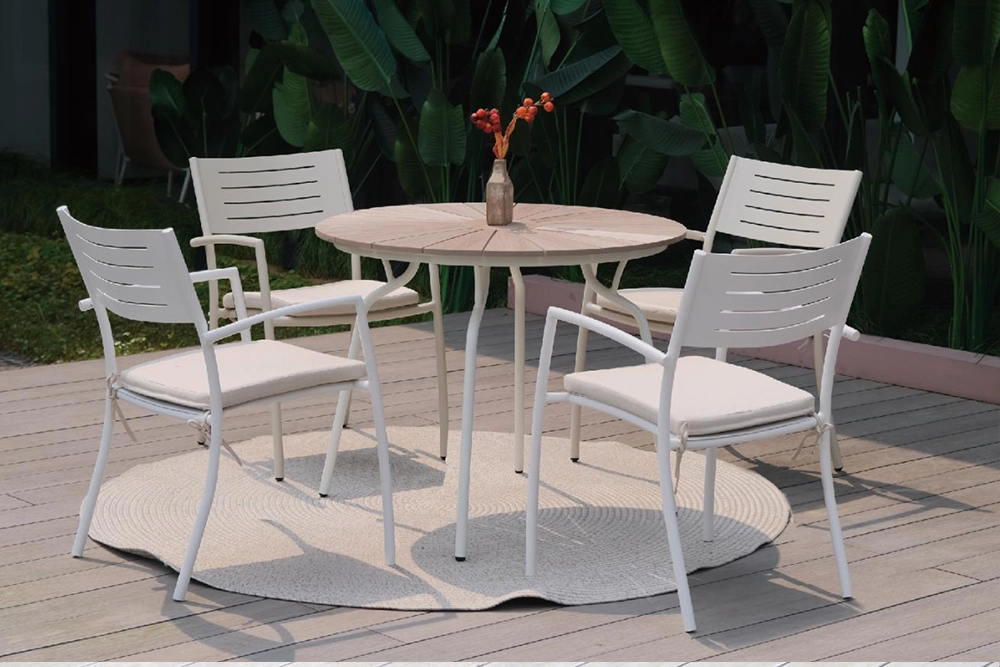
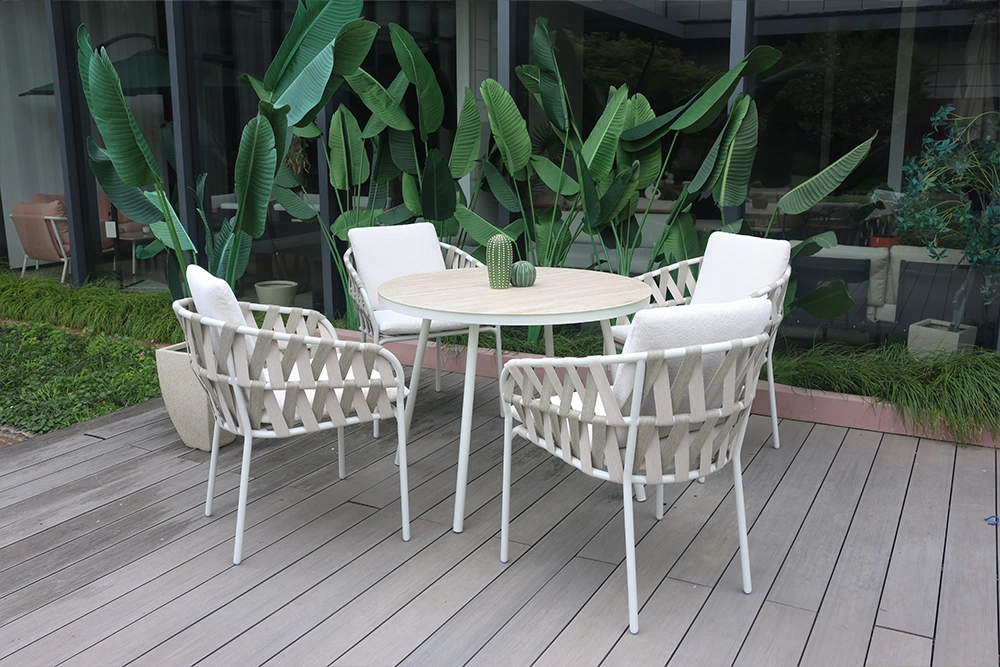
A round patio dining table is a circular outdoor dining surface that is built on a pedestal or four-leg frame and engineered to seat between two and six diners around an equidistant perimeter. Its symmetric geometry encourages face-to-face conversation, eliminates head-of-table hierarchy, and minimizes wasted corner space on compact patios.
What Are the Standard Sizes and Seating Capacities of Round Patio Dining Tables?
Round patio dining table sizes cluster around four diameter ranges, each mapped to a specific seating count and use case:
- 80–90 cm diameter seats two to four diners and fits balconies, bistro corners, and breakfast nooks where every centimeter counts.
- 100–120 cm diameter seats four diners comfortably and serves as the default for standard residential patios.
- 130–150 cm diameter comfortably accommodates four to six diners depending on chair width, and suits mid-sized gardens and residential terraces. Aluminum frames dominate this segment because they keep assembly weight manageable — a design logic visible in five-piece aluminum-framed round dining sets with PS wood tabletops sized at 130 centimeters, where the set ships with four chairs and the table perimeter supports adding a fifth or sixth if needed.
- Above 150 cm diameter can technically seat six to eight, but center-reach distance for shared dishes becomes impractical beyond 160 cm.
How Does Table Base Type Affect Round Patio Dining Table Seating Flexibility?
Round patio dining table base type directly determines seating flexibility. A pedestal base eliminates leg interference and lets diners pull chairs to any point around the perimeter, making it the preferred choice for round tables intended to seat five or more. A four-leg base, on the other hand, remains a practical and stable solution for four-person configurations where leg interference is minimal — the four legs anchor the frame symmetrically, keep the table close to the ground, and simplify manufacturing, which is why four-leg round tables dominate the standard residential dining segment.
Why Do Round Patio Dining Tables Offer Better Outdoor Wind Stability?
Round patio dining tables distribute weight evenly around a central axis, producing a lower and more balanced center of gravity than rectangular tables of comparable surface area. Four-leg round tables reinforce this advantage further, because the four evenly spaced legs create a wide, grounded support footprint that resists tipping on exposed rooftop terraces and coastal patios where wind loads are unpredictable.
What Is a Rectangular Patio Dining Table?
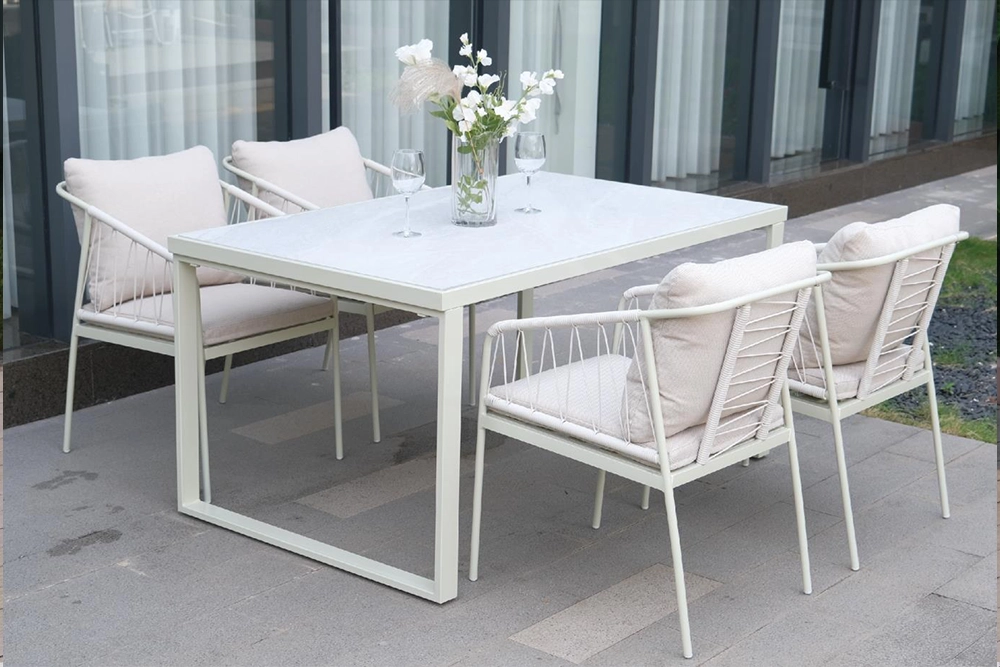
A rectangular patio dining table is an elongated outdoor dining surface that is supported by a four-leg or trestle frame and engineered to seat between four and ten diners along its long edges. Its linear geometry maximizes seating per square meter and aligns naturally with long terraces and hospitality layouts.
What Are the Standard Sizes and Seating Capacities of Rectangular Patio Dining Tables?
Rectangular patio dining table sizes follow a predictable length-to-seating progression that buyers can use to match table scale to expected headcount:
- 120 × 70 cm seats four diners and fits compact residential patios.
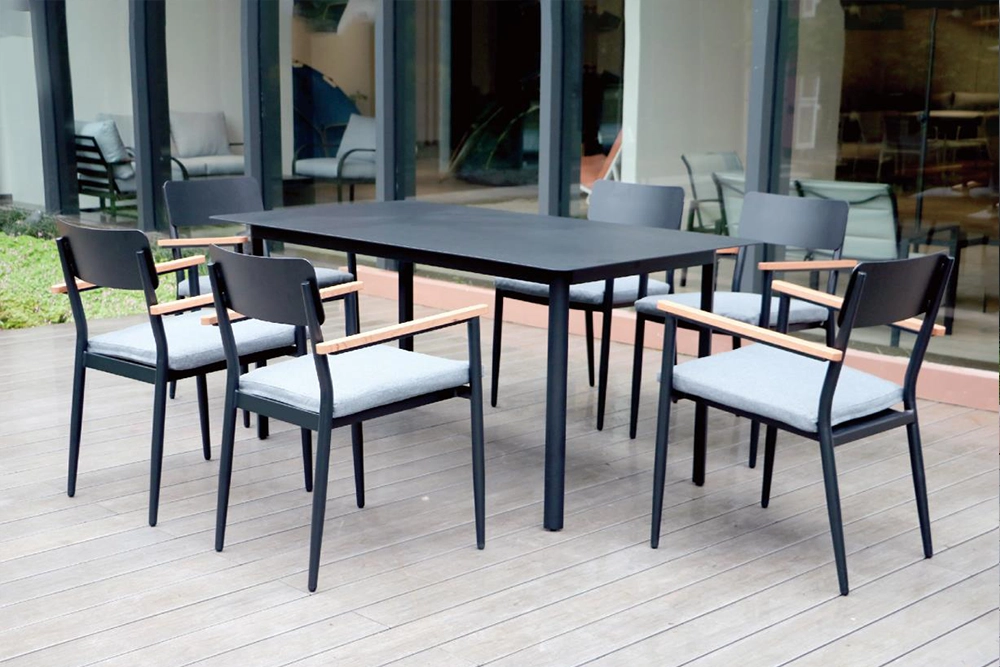
- 150–160 × 90 cm seats six diners — the natural fit for standard family terraces. At this scale, hybrid frame construction offers a practical balance: steel chair frames supply structural rigidity, while a steel-and-aluminum hybrid table frame keeps the tabletop assembly lighter. The combination appears in seven-piece outdoor dining sets pairing steel-framed chairs with a steel-aluminum hybrid table frame and a poly stone tabletop measuring 160 by 90 centimeters, a format built specifically for six-person family dining.
- 180–200 × 100 cm seats eight diners and suits larger gardens and hospitality terraces. At the 200 cm mark, full-aluminum frames become the dominant solution because aluminum can span two meters without the weight penalty steel incurs at this scale — a trade-off visible in nine-piece aluminum dining sets with an artificial wood tabletop spanning 200 by 100 centimeters and eight cushioned armchairs, where the frame must maintain full structural integrity across the entire unsupported span.
- 220 cm and above seats ten and targets restaurant outdoor sections and event venues.
A steel-framed seven-piece outdoor dining set featuring a 160 × 90 cm poly stone tabletop and six olefin-cushioned chairs — sized for six-person family dining on mid-sized residential patios.
Why Are Rectangular Patio Dining Tables Compatible with Outdoor Benches?
Rectangular patio dining tables are bench-compatible because their long parallel edges create a continuous seating line that matches a bench’s linear form. A single 150 cm bench replaces two or three individual chairs along one side, saving floor space and adding flexible overflow capacity for children or unexpected guests.
What Are the Key Differences Between Round and Rectangular Patio Dining Tables?
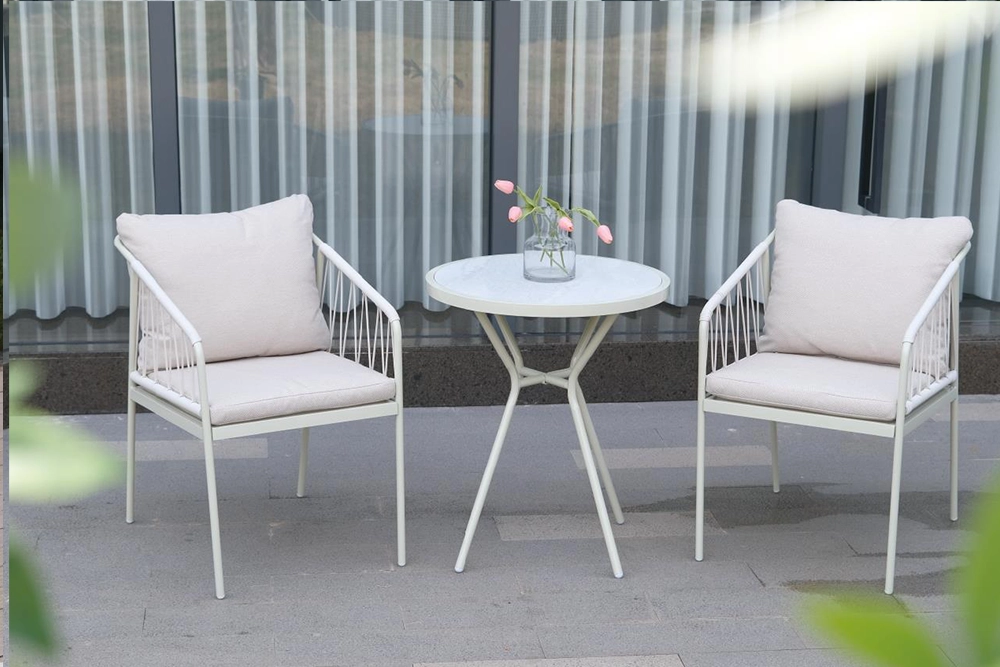
The following table summarizes the seven core dimensions where round and rectangular patio dining tables diverge in practical performance:
| Dimension | Round | Rectangular |
| Optimal floor footprint | Square or circular open area | Long, narrow corridor or terrace |
| Seating efficiency per m² | Lower | Higher |
| Conversational geometry | All diners face center equally | Diners face across long axis; ends isolated |
| Wall and rail placement | Wastes space against walls | Sits flush against walls and rails |
| Visual formality | Casual and intimate | Formal and structured |
| Bench compatibility | Not compatible | Fully compatible |
| Outdoor wind stability | Higher — lower center of gravity | Lower — more vulnerable to lateral gusts |
What Are the Advantages and Disadvantages of Round and Rectangular Patio Dining Tables?
Round patio dining tables offer superior conversational flow, equal access to shared dishes, a smaller corner footprint, no sharp edges for child-safe environments, and better wind stability on exposed terraces. The trade-offs are lower seating density, poor space efficiency against walls, a diameter-locked seating cap, impractical center-reach beyond 150 cm, and no bench compatibility.
Rectangular patio dining tables deliver maximum seating density, full bench compatibility, natural alignment with linear architecture, and easy multi-table joining for banquet layouts. The trade-offs are fragmented conversation between table ends, a larger overall footprint, poor fit on square balconies, and higher structural engineering requirements at long spans.
How to Choose Between Round and Rectangular Patio Dining Tables for a Specific Patio?
Choosing between round and rectangular patio dining tables comes down to three measurable factors: the shape of the available floor area, the typical seating count, and the social use case.
When to choose round: the patio footprint is square or nearly square, the household rarely exceeds four diners, the space serves a conversational function, children are present and sharp corners are a concern, or the terrace is wind-exposed and stability matters.
When to choose rectangular: the patio is long and narrow, the household regularly seats six or more, the venue requires high-density throughput, bench seating is desired, or multi-table joining for events is anticipated.
When to consider a third option: buyers whose patio is long but whose priority is conversational dining should evaluate oval or racetrack tables — hybrid shapes combining rectangular seating density with rounded geometry. Square tables serve the four-person niche on compact square patios where neither round nor rectangular is ideal.
What Decision Factors Should Buyers Measure Before Specifying Table Shape?
Three quantitative checks resolve most shape decisions. First, the floor area’s length-to-width ratio: ratios above 1.5 favor rectangular, below 1.2 favor round. Second, the peak simultaneous diner count across a typical year. Third, the 90-centimeter (36-inch) clearance rule — every side of the table needs at least 90 cm for chair pull-out and walking traffic. A 130 cm round table requires a minimum room width of 310 cm; a 160 × 90 cm rectangular table requires at least 340 × 270 cm. Each diner occupies roughly 60 cm of table edge, setting the hard cap on how many seats a given perimeter or length can support.
Which Frame and Tabletop Materials Work Best for Both Round and Rectangular Patio Dining Tables?
Both round and rectangular patio dining tables are most commonly built on powder-coated aluminum or steel frames, with tabletops in tempered glass, ceramic, poly stone, PS wood, or artificial wood. Material choice is independent of shape — the same aluminum alloy performs identically whether cut into a circular or rectangular profile. Powder-coated aluminum remains the dominant frame material across both shapes because it resists corrosion without maintenance, while tabletop selection increasingly splits between ceramic (scratch-resistant, heat-stable) and poly stone or artificial wood (lighter weight, natural aesthetic, lower cost).
Which Patio Dining Table Shape Works Better for Residential, Hospitality, and Commercial Projects?
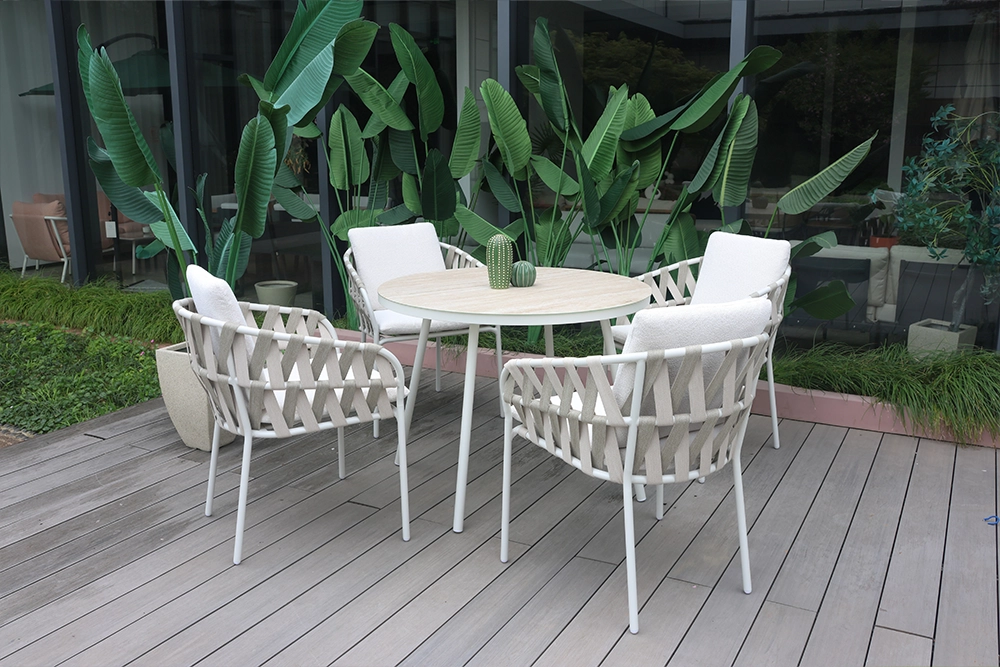
Round patio dining tables dominate residential balconies, boutique hotel courtyards, and intimate restaurant corners where conversation quality matters more than seat count. Rectangular patio dining tables dominate resort breakfast terraces, restaurant outdoor sections, and public dining spaces where seating density and linear traffic flow drive the brief. In mixed-use hospitality projects, the most common layout uses rectangular tables for the main dining floor and reserves one or two round tables for premium corner positions.
FAQs
Which Patio Dining Table Shape Seats More People in the Same Floor Area?
Rectangular tables seat more people per square meter because diners sit along both long edges. A 160 × 90 cm rectangular table seats six in roughly 1.44 m² of tabletop, while a round table needs a 130 cm diameter (1.33 m²) just to seat four to five.
Is a Round or Rectangular Patio Dining Table Better for a Small Balcony?
Round tables are generally better for small balconies because their circular footprint eliminates corner overhang. An 80–90 cm round table fits balconies as narrow as 2.5 meters while still seating two to four.
Which Tabletop Material Lasts Longest on a Patio Dining Table?
Ceramic and poly stone tabletops rank highest for long-term outdoor durability. Both resist scratching, UV fading, and moisture absorption without periodic sealing. Tempered glass performs well but is more vulnerable to thermal shock. Artificial and PS wood tabletops deliver a warmer aesthetic but benefit from periodic protective treatment.
What Is the Minimum Patio Width for a 150 cm Round Patio Dining Table?
A 150 cm round table requires a minimum patio width of 330 cm (150 cm table + 90 cm clearance on each side). Hospitality projects typically specify 390 cm to accommodate server circulation.
How Many Chairs Should Pair with a 150 cm Round vs a 180 cm Rectangular Patio Dining Table?
A 150 cm round table pairs with five to six chairs, each occupying roughly 60 cm of perimeter. A 180 cm rectangular table pairs with six chairs — two on each long side and one on each end — though replacing one long side with a bench can push effective capacity to seven or eight.
Want to Know More About Our Products?
View All Products NowAbout Author
Spring Nee
Spring Nee is the Sales & Marketing Director at Zhejiang Sunshine Leisure Products Co., Ltd. With nearly 20 years of experience in the outdoor leisure furniture industry, she specializes in camping chairs, beach chairs, folding outdoor seating, and OEM/ODM project communication. Spring also leads the company’s marketing content direction. Most of the articles published on this website are either written by Spring herself or reviewed by her before publication, ensuring that the content is practical, accurate, and based on real industry experience.